

The Purple Book isn’t a novel you read for fun-it’s the U.S. Food and Drug Administration’s official, searchable database that tells you which biological medicines are approved, which ones are biosimilars, and which ones can be swapped out like generics. If you’re a pharmacist, a prescriber, or even a patient trying to understand why your insulin or rheumatoid arthritis drug changed, the Purple Book is the place to look. It’s not marketing material. It’s the law in digital form.
What Exactly Is the Purple Book?
The Purple Book is the FDA’s public record of all licensed biological products in the United States. That includes the original biologics-like Humira, Enbrel, and Lantus-and the newer versions that copy them: biosimilars and interchangeable products. Before 2020, this information was split into two separate lists, one for drugs handled by CDER and another for biologics under CBER. That made it confusing. Now, it’s one clean, searchable database updated in real time. Each product card in the Purple Book shows the brand name, the generic name, the date it was approved, and whether it’s a reference product, a biosimilar, or an interchangeable product. The color of the card matches across related products-so if you see two cards in purple, you know one is the original and the other is a copy that’s been approved as biosimilar or interchangeable. There are also icons showing how the medicine is delivered: autoinjector, pre-filled syringe, or vial. No guesswork. Just facts.Biosimilar vs. Interchangeable: The Key Difference
Not all biosimilars are created equal. All interchangeable products are biosimilars, but only a few biosimilars make it to interchangeability. Here’s why that matters. A biosimilar is a biological product that’s highly similar to the original (called the reference product). The FDA requires proof that there are no clinically meaningful differences in safety, purity, or potency. That means it works the same way in the body. But that’s not enough for substitution. An interchangeable product goes further. To earn that label, the manufacturer must prove that switching back and forth between the biosimilar and the original doesn’t increase risk or reduce effectiveness. That means if you start on the reference drug, switch to the biosimilar, then switch back, your body responds the same every time. This isn’t just theoretical-it’s tested in clinical trials where patients alternate between the two products over months. The FDA is clear: interchangeability doesn’t mean the product is better. It just means you can swap it in without needing a new prescription. That’s the whole point.Why Interchangeability Matters for Pharmacists and Patients
For pharmacists, the Purple Book is a daily tool. When a doctor prescribes a biologic like Humira, the pharmacist checks the Purple Book to see if there’s an interchangeable version available. If there is, and if state law allows it, the pharmacist can swap it out without calling the doctor. But here’s the catch: state laws vary. As of 2023, 47 states and Puerto Rico let pharmacists substitute interchangeable biosimilars without prior approval from the prescriber. In those states, the pharmacist must still notify the doctor and document the swap. In the other three states, the prescriber must give explicit permission every time. That creates a patchwork. A patient in California might get a cheaper, interchangeable biosimilar automatically. The same patient in New York might get the brand name unless their doctor specifically authorizes a switch. The FDA sets the federal standard, but pharmacy boards set the local rules.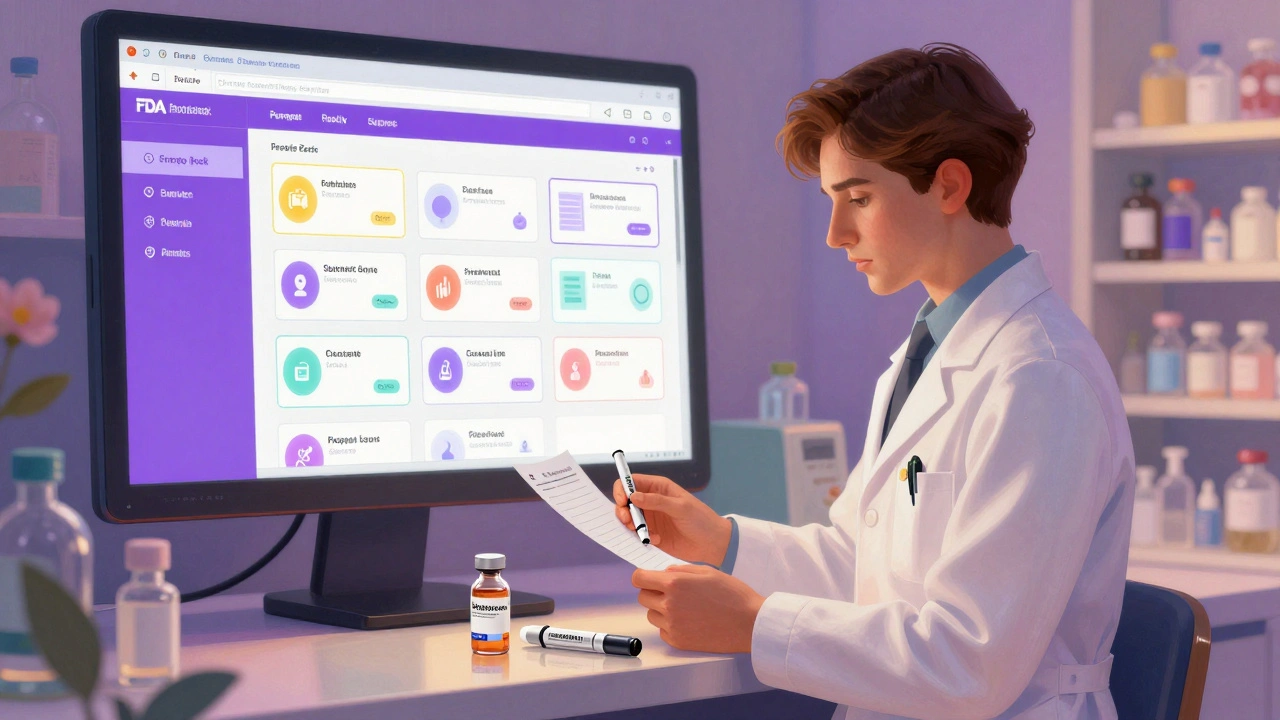
How Many Interchangeable Products Are There?
As of late 2023, only seven biosimilars had received the interchangeable designation from the FDA. That’s out of dozens of approved biosimilars. Why so few? Because the bar is high. The approved interchangeable products include:- Two insulin products (used for diabetes)
- Three treatments for inflammatory conditions like rheumatoid arthritis and Crohn’s disease
- Two therapies for eye conditions like macular degeneration
What the Purple Book Doesn’t Tell You
The Purple Book is authoritative, but it’s not a full guide. It won’t tell you:- How much a biosimilar costs compared to the original
- Whether insurance covers it without prior authorization
- How patients respond in real-world settings beyond clinical trials

What’s Next for the Purple Book?
The FDA is working on clearer labeling rules for biosimilars and interchangeable products. Right now, labels can be confusing. A patient might see “biosimilar to Humira” on the box, but not understand what that means for them. New guidance aims to fix that. More products will come. The pipeline is full. Companies know there’s money in interchangeable biosimilars-because they can be substituted without a doctor’s intervention. That’s the biggest cost-saver in biologics. But the real challenge isn’t science. It’s education. Many doctors still don’t know the difference between biosimilar and interchangeable. Many patients worry that a copycat drug is less safe. The Purple Book gives the facts. Now, the healthcare system needs to make sure those facts reach the people who need them.How to Use the Purple Book
If you’re a provider or pharmacist, here’s how to use it:- Go to fda.gov/purplebook (the link is for reference only; do not include in final output)
- Use the search bar to type in the brand name or generic name of the biologic
- Look for the product card color-matching colors mean biosimilar or interchangeable
- Check the designation: 351(a) = reference product, 351(k) Biosimilar, 351(k) Interchangeable
- Click on the product to see the approval date, exclusivity status, and product presentation
What is the Purple Book used for?
The Purple Book is the FDA’s official database that lists all approved biological products in the U.S., including reference products, biosimilars, and interchangeable products. It helps healthcare providers, pharmacists, and patients identify which biologics are approved as interchangeable and can be substituted at the pharmacy level without a new prescription.
Are all biosimilars interchangeable?
No. All interchangeable products are biosimilars, but not all biosimilars are interchangeable. To be labeled interchangeable, a product must prove through clinical studies that switching between it and the original biologic doesn’t increase health risks or reduce effectiveness-even if a patient switches back and forth multiple times.
Can pharmacists automatically substitute interchangeable biosimilars?
It depends on the state. In 47 states and Puerto Rico, pharmacists can substitute an interchangeable biosimilar without needing permission from the prescriber. In the other three states, the prescriber must approve the swap. Pharmacists must still notify the doctor and document the substitution, regardless of state law.
How many interchangeable biosimilars are approved by the FDA?
As of late 2023, seven biosimilars have received FDA interchangeability designation. These include two insulins, three drugs for inflammatory diseases like rheumatoid arthritis, and two treatments for eye conditions. More are under review, but the approval process is rigorous and requires additional clinical data beyond standard biosimilarity.
Does interchangeability mean the biosimilar is safer or more effective?
No. The FDA explicitly states that interchangeability does not mean the biosimilar is safer or more effective than a non-interchangeable biosimilar. It only means that switching between the biosimilar and the original product is as safe and effective as staying on the original alone.


