
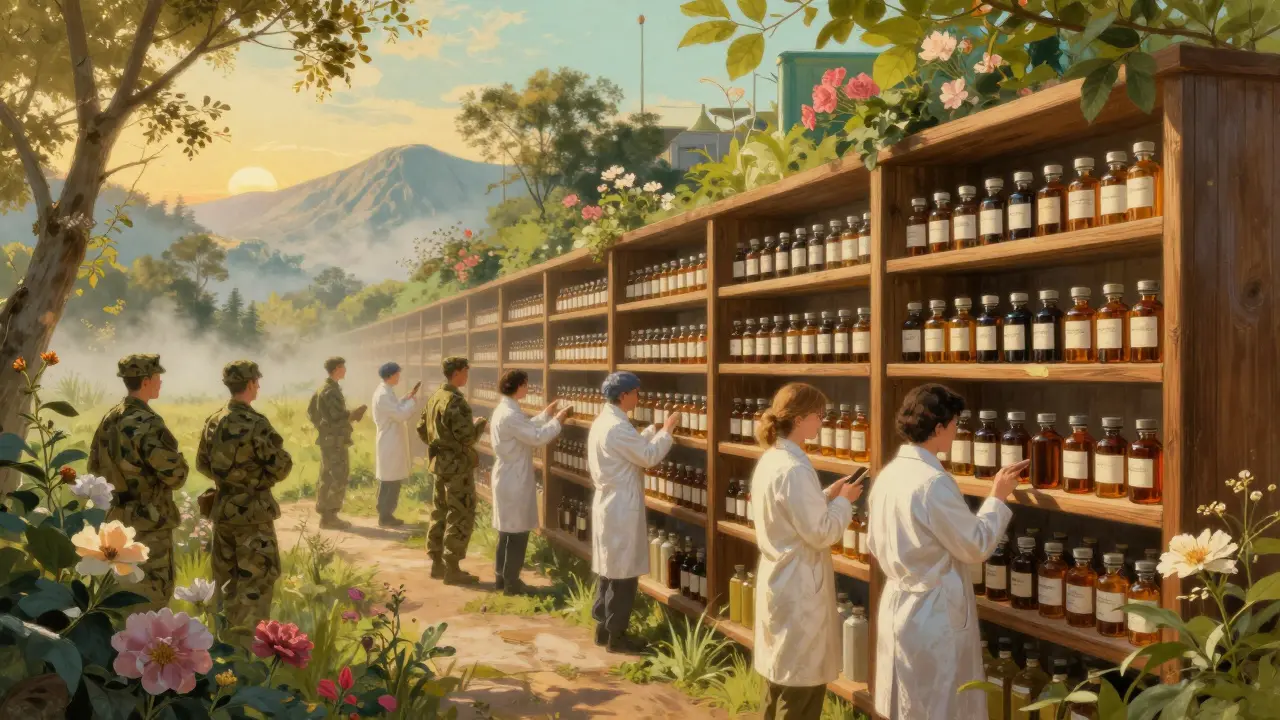
Why Expired Medications Aren't Always Useless
When you see an expiration date on a medicine bottle, you probably think it's time to toss it. But for military stockpiles, that's not the whole story. The Shelf-Life Extension Program (SLEP) is a federal program established in 1986 that tests and extends the shelf life of critical medical supplies stored by the U.S. government. This program has shown that many drugs stay effective years beyond their labeled dates-saving billions and keeping emergency medical supplies ready when they're needed most.
How SLEP Works: Testing and Extensions
The Department of Defense (DoD) runs SLEP, while the FDA handles the actual testing. Drugs in federal stockpiles get tested every 1-3 years. For a drug to qualify for extension, it must keep at least 85% of its original potency. The DoD Shelf Life Extension System (SLES) tracks all this data. It's like a giant database that stores results from past tests. Only certain drugs are eligible-those labeled as Type II. Type I drugs can't be extended at all.
Here's how the process works step by step. First, participating agencies nominate drugs for testing. The FDA then collects samples from stockpiles. Testing happens in FDA labs, where they check for potency, purity, and safety. If the drug meets the 85% potency requirement, the FDA approves an extension. The Materiel Quality Control Storage Standards (MQCSS) dictate how these drugs must be stored to qualify. Proper temperature and humidity control are critical. Without it, even drugs that passed testing could degrade quickly.
Key Findings from SLEP Testing
A 2006 study in the Journal of Pharmaceutical Sciences tested 122 drugs. Shockingly, 88% stayed stable beyond their expiration dates. Some even kept potency for over 15 years! The Government Accountability Office (GAO) found SLEP saved $2.1 billion between 2005 and 2015. That's a huge chunk of change. Meanwhile, commercial drug waste costs about $1.7 billion every year. SLEP's approach is way more efficient.
For example, the FDA's 2022 Annual Report showed that 92% of tested lots received shelf-life extensions averaging 2.8 years per cycle. This isn't just about money-it's about readiness. During the 2009 H1N1 flu pandemic, Tamiflu stockpiles extended through SLEP kept hospitals supplied when fresh shipments couldn't keep up with demand.
| Aspect | SLEP Program | Commercial Practice |
|---|---|---|
| Expiration Testing | Periodic stability testing every 1-3 years | Manufacturer's initial studies, no retesting |
| Potency Requirement | Minimum 85% of original potency | Strict adherence to labeled date |
| Waste Reduction | 42% less waste in military kits | $1.7B annual waste from discarded drugs |
| Storage Conditions | Controlled environments per MQCSS | Varies by retailer, often less controlled |
| Extension Success Rate | 92% for fully compliant facilities | 0%-no extensions for commercial products |

Real-World Impact: Saving Lives and Money
The Strategic National Stockpile (SNS) relies on SLEP to keep critical supplies ready. In 2019, they extended Tamiflu's shelf life by 3 years, saving 22 million treatment courses. The Army Medical Logistics Support Activity reported a 42% drop in waste from battlefield medical kits after using SLEP. Military treatment facilities saved $87 million annually by cutting drug waste. These numbers aren't just statistics-they mean more supplies for emergencies when they're needed most.
A 2020 report from the US Army Medical Materiel Agency showed that facilities fully implementing SLEP procedures achieved 92% extension success rates compared to 68% for partially compliant facilities. This difference comes down to proper storage and timely testing. For instance, the DoD's 2022 report noted that facilities following MQCSS guidelines had 30% fewer failed tests than those that didn't.
Challenges and Limitations
But SLEP isn't perfect. A 2018 survey of military logistics staff found 35% had trouble accessing SLES data. Resolving those issues took over a week on average. Some experts also caution against generalizing SLEP results. Dr. Michael D. Swartzburg, a pharmaceutical stability expert, says: "SLEP's findings only apply to properly stored military stockpiles. They don't mean your home medicine cabinet can ignore expiration dates." The FDA's 2021 guidance makes it clear: extensions are specific to each lot and storage condition. You can't apply them broadly.
Another challenge is the sheer volume of drugs needing testing. The program has extended over 2,500 different products by 2022, but the process takes time. A 2022 DLA report showed average testing cycle time of 11.4 months. For emergencies like pandemics, that delay can be problematic. That's why the FDA and DoD rolled out a new electronic data sharing system in December 2022, cutting extension decision time from 14.3 months to 8.1 months.

The Future of Drug Stability Programs
SLEP keeps evolving. In 2021, it expanded to include some biological products, though they're still a small part of the program. The 2023 National Defense Authorization Act added provisions to cover more medical countermeasures for chemical, biological, radiological, and nuclear threats. But this expansion needs more funding-around $75 million extra annually, according to a 2023 Congressional Budget Office report.
Experts are pushing for better predictive modeling to handle next-gen medical countermeasures. The FDA's 2022-2026 Strategic Plan for Medical Countermeasures identifies 'expanding the scientific basis for shelf-life extension of critical products' as a priority. They're exploring advanced techniques like mass spectrometry and accelerated stability testing. As Dr. Joanne Lesigues, FDA's Office of Inspections and Investigations director, said: "SLEP balances public health needs with fiscal responsibility. It's a scientifically sound approach."
Frequently Asked Questions
Can civilians use SLEP to extend their personal medications?
No. SLEP is strictly for federal government stockpiles. The program doesn't apply to individual medications. The FDA explicitly states that shelf-life extensions from SLEP are specific to the lot numbers, storage conditions, and packaging identified in the extension. Your personal medications should always follow the expiration date on the label.
How long can drugs stay stable under SLEP?
It varies. Some drugs maintain potency for over 15 years past their original expiration date. The 2006 Journal of Pharmaceutical Sciences study found 88% of tested drugs were stable beyond expiration, with some lasting decades. However, each extension is based on specific testing for each lot. For example, Tamiflu was extended by 3 years in 2019, while other drugs may get shorter extensions based on their stability data.
Why doesn't the FDA extend expiration dates for all drugs?
Commercial drug manufacturers don't test drugs after their initial expiration date. SLEP is unique because it's a government-run program focused on critical stockpiles where waste could harm national security. The FDA's standard practice for commercial drugs is based on manufacturer-provided stability data, which only covers the labeled expiration period. Extending commercial drug dates would require new regulations and testing protocols that don't currently exist.
What happens if a drug fails SLEP testing?
If a drug fails to meet the 85% potency requirement during testing, it's removed from stockpiles and replaced. The FDA works with the DoD to identify why it failed-often due to improper storage or packaging issues. For example, if humidity levels in a storage facility were too high, the facility must fix the problem before retesting. This ensures only safe, effective drugs remain in emergency stockpiles.
How does SLEP compare to similar programs in other countries?
Twelve NATO allies developed similar shelf-life extension programs based on SLEP's framework by 2022. However, most countries have smaller-scale versions. For instance, the UK's Ministry of Defence runs a limited extension program, but it doesn't cover as many drug types as SLEP. Canada and Australia also have programs, but they focus mainly on vaccines and antibiotics rather than the broad range of medical countermeasures SLEP handles. SLEP remains the most comprehensive government-run system globally.


