

When a patient skips a dose because the pill costs too much, it’s not just a personal choice-it’s a system failure. Medication adherence isn’t about forgetfulness. It’s often about affordability. And when generic drugs cost 80-85% less than their brand-name equivalents, adherence jumps. Not a little. Not a little bit. Generic drug prices directly determine whether people take their medicine-or don’t.
Consider this: 32.7% of U.S. adults admitted in a 2023 JAMA survey that they skipped doses, delayed refills, or didn’t fill prescriptions at all because of cost. That’s more than one in three people. For someone managing diabetes, high blood pressure, or depression, that’s not a minor lapse. It’s a health crisis waiting to happen.
Why Cost Stops People from Taking Their Medicine
It’s simple math. If your copay for a brand-name statin is $75 a month, and the generic version is $5, the choice isn’t complicated. But insurance formularies don’t always make that easy. Many plans put brand-name drugs on lower cost tiers-meaning higher out-of-pocket payments-just because they’re newer or more heavily marketed. That’s not clinical logic. It’s financial logic.
Studies show a clear pattern: every $10 increase in out-of-pocket cost drops adherence by 2-4%. For GLP-1 drugs used in diabetes, each $10 rise cuts adherence likelihood by 3.7%. That’s not a correlation. That’s a direct cause-and-effect. And it’s not just about pills. It’s about hospital beds, emergency rooms, and preventable deaths.
The CDC estimates medication non-adherence causes over 100,000 deaths a year in the U.S. and adds $100-$300 billion in avoidable healthcare spending. That’s more than the entire annual budget of the Department of Education. And it’s not because patients are irresponsible. It’s because the system makes taking medicine unaffordable.
Generics Aren’t Cheaper Because They’re Weaker
One of the biggest myths is that generics are less effective. They’re not. The FDA requires generics to have the same active ingredient, strength, dosage form, and route of administration as the brand-name drug. They must also be bioequivalent-meaning they deliver the same amount of medicine into the bloodstream within 80-125% of the brand’s rate. In plain terms: they work the same way, in the same amount of time.
Take statins. Atorvastatin (Lipitor) and rosuvastatin (Crestor) were once expensive brand-name drugs. When Medicare Part D moved them to the lowest cost tier-where generics belong-adherence jumped by 5.9%. That’s not a small uptick. That’s thousands of people who stopped having heart attacks because they could afford to take their pills.
A 2011 study on breast cancer patients on aromatase inhibitors found the same thing. Those on brand-name drugs had a 22.3% discontinuation rate. Those on generics? 17.8%. Adherence rates? 68.4% for brand, 73.1% for generic. The difference wasn’t in the drug. It was in the price tag.
How Insurance Tiers Shape Behavior
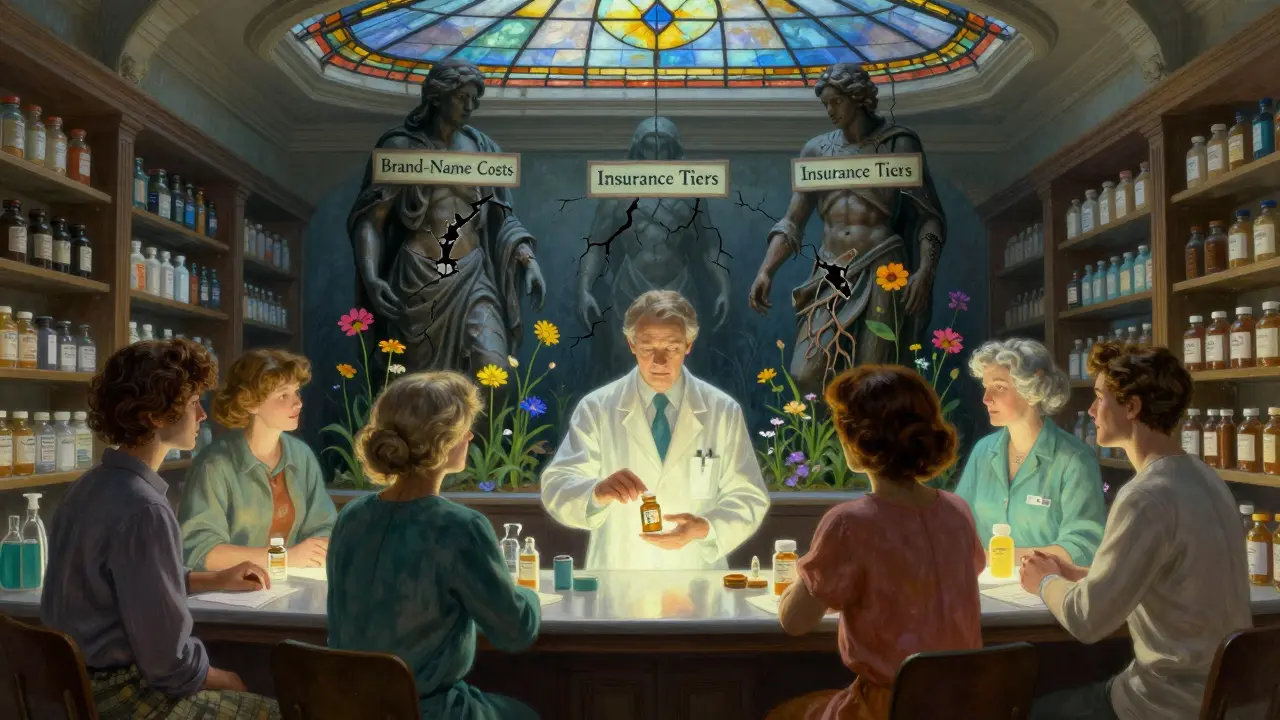
Insurance plans use tiered formularies to steer patients toward cheaper drugs. But they don’t always do it right. Some plans still put generics on higher tiers if they’re newer or if the manufacturer pays for placement. That’s backward. The goal should be to make the best, cheapest option the easiest option.
Here’s how it works in practice:
- Tier 1: Generics - $5-$10 copay
- Tier 2: Preferred brands - $30-$50 copay
- Tier 3: Non-preferred brands - $75-$150+ copay
When a patient sees a $75 copay for a brand-name drug and a $5 copay for the generic, the decision is obvious. But when the brand is on Tier 1 and the generic is on Tier 2? That’s where things go wrong. Patients get confused. They think the brand is better. They’re not wrong to think that-because the system told them so.
Real-time benefit tools (RTBTs) are changing that. These tools show doctors the exact cost of a prescription before they write it. In pilot programs, RTBTs improved adherence by 12-15%. Why? Because doctors started prescribing what patients could afford. One cardiologist told a patient, “I’m switching you to generic rosuvastatin. It’s the same drug. It’ll cost you $5 instead of $75.” The patient replied, “I’ve been skipping doses for two years. I didn’t know I could afford this.”

Real Stories Behind the Numbers
Reddit threads like r/healthinsurance are full of raw, unfiltered stories. One user, u/HeartHealthJourney, wrote: “After my cardiologist switched me from brand-name Crestor ($75 copay) to generic rosuvastatin ($5 copay), I went from missing 3-4 doses weekly to perfect adherence for 11 months straight.” That’s not a statistic. That’s a life.
Another user, u/Type2Survivor, shared: “I was on metformin brand for a year. Copay was $60. I’d take it for two weeks, then run out. Switched to generic-$3. I haven’t missed a dose in 14 months. My A1C dropped from 8.9 to 6.1.”
These aren’t outliers. They’re symptoms of a broken system that finally started fixing itself.
What’s Changed-and What’s Still Broken
The Inflation Reduction Act of 2022 capped insulin at $35/month. Medicare’s new $2,000 annual out-of-pocket cap for Part D starts in 2025. These are huge wins. They’ll help 1.4 million Medicare beneficiaries stay on their meds.
But here’s the problem: most of these reforms only apply to Medicare. What about the 160 million Americans under private insurance? What about those who don’t have insurance at all? The generic drug market saves the U.S. $643 billion every decade. Yet, 90% of prescriptions are still filled with generics-because they’re cheaper, not because they’re pushed harder.
Therapeutic duplication is another silent killer. A patient might be on three different blood pressure meds because each was prescribed by a different specialist. That’s not care. That’s waste. Medication therapy management programs-where pharmacists review all a patient’s drugs-can cut that duplication by 30%. But they’re still rare.
The Bigger Picture: Value-Based Insurance Design
The future isn’t just about lowering prices. It’s about aligning cost with value. What if your copay for a diabetes drug that cuts hospitalizations by 40% was $0? What if your copay for a drug with no proven benefit was $100?
Pilot programs using this “value-based insurance design” have already shown 18.3% adherence improvements for high-value medications in heart disease and diabetes. That’s not magic. It’s smart economics. Pay less for what works. Pay more for what doesn’t.
The FDA’s 2023 Generic Drug User Fee Amendments (GDUFA III) are funding $1.1 billion to speed up generic approvals. By 2027, over 1,500 new generics will hit the market. That’s more competition. More choice. Lower prices.
What Patients and Providers Can Do Now
You don’t need to wait for policy changes. Here’s what you can do today:
- Ask your doctor: “Is there a generic version?”
- Use GoodRx or SingleCare to compare prices at nearby pharmacies.
- If your copay is high, ask if your insurer has a mail-order option-often cheaper.
- Request a prior authorization if your drug is stuck on a high tier.
- Ask your pharmacist: “Can I switch to a different generic? Sometimes one brand of generic is cheaper than another.”
Doctors: Use real-time benefit tools. Ask patients about cost before prescribing. Don’t assume they can afford it. Assume they can’t-and work from there.
The system isn’t perfect. But the data is clear: when generic prices are low, people take their medicine. When they take their medicine, they live longer, healthier lives-and the system saves billions.
Lower cost doesn’t mean lower quality. It just means better access. And that’s not just good economics. It’s good medicine.