
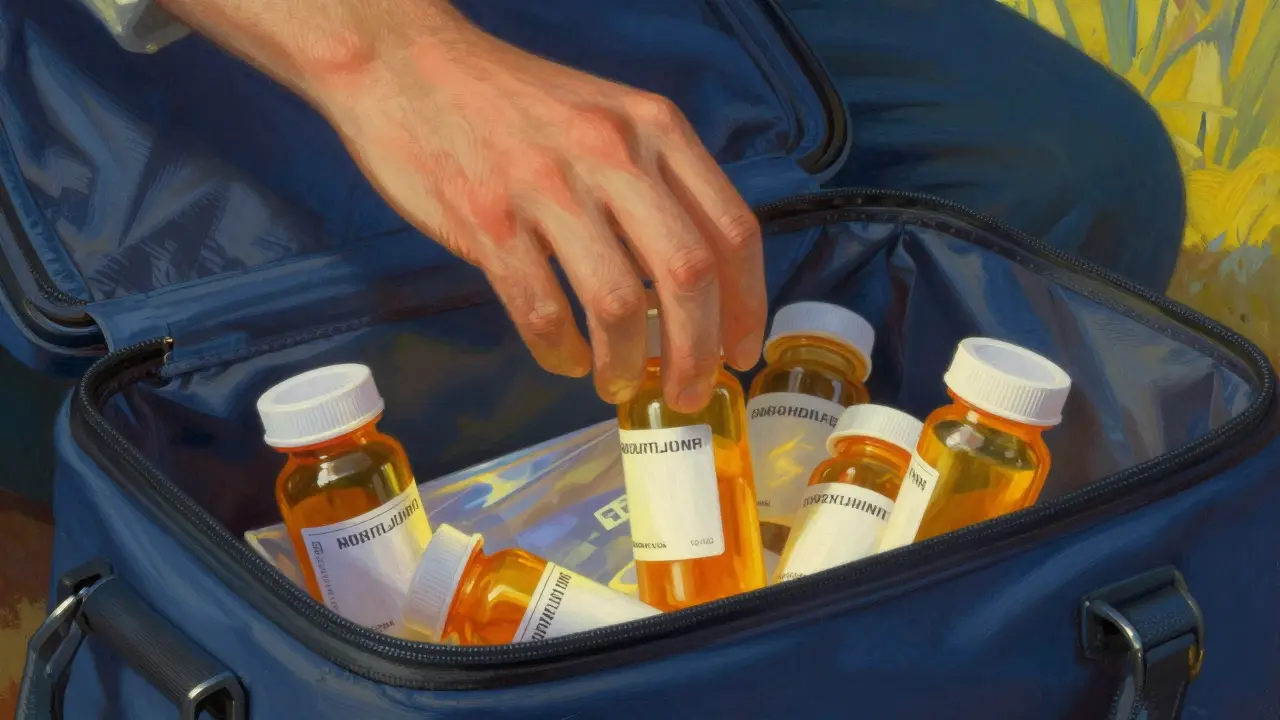
Imagine arriving at the security checkpoint only to have your essential medication confiscated because it was in a generic pill organizer. It happens more often than you'd think. According to the National Business Travelers Association, nearly 28% of business travelers have faced security delays specifically due to their meds. Whether you're managing a chronic condition or just carrying a few prescriptions, the stakes are high-missing a dose or letting a biologic drug overheat can turn a dream vacation into a medical emergency. The goal here is to get you through the airport without a hitch and keep your medicine effective until you land.
| Item | TSA/FAA Requirement | Pro Tip |
|---|---|---|
| Packaging | Original pharmacy container with label | Avoid pill organizers for security screening |
| Liquids | Exempt from 3.4oz limit if medically necessary | Declare them immediately to the agent |
| Cooling | Frozen gel packs in insulated bags | Freeze packs 24 hours before departure |
| Documentation | Prescription + Physician's letter | Keep a digital copy on your phone |
The Golden Rule: Stick to Original Packaging
It's tempting to transfer everything into a compact travel case to save space, but that's a gamble you shouldn't take. Packing medications for air travel is largely about verification. The TSA (Transportation Security Administration) requires medications to stay in original containers with labels showing your name, the drug name, dosage, and the prescribing doctor.
This isn't just a security formality. Dr. Marcia Wyman from the Cleveland Clinic points out that repackaging can expose drugs to moisture and light, potentially cutting their potency by 30% in just three days. If you absolutely must use a pill organizer for convenience during the flight, pack the original bottles in your bag alongside it. If the agent questions the organizer, you have the official proof right there.
Handling Liquid Medications and the 3.4-Ounce Limit
Most travelers know the "3-1-1" rule for liquids, but medical needs are a major exception. You are allowed to carry liquid medications that exceed the 100 mL limit, provided they are medically necessary. While the FAA (Federal Aviation Administration) suggests a general limit of 2,000 mL for carry-ons without special approval, there is no hard upper limit for essential medicine as long as you declare it.
To make this process seamless, tell the TSA agent you have medically necessary liquids before your bag goes through the X-ray. Having a doctor's letter on official letterhead can speed this up significantly, especially for pediatric medications. Some parents have reported that agents may measure the bottle, but as long as the prescription matches, you'll be cleared through.
Protecting Temperature-Sensitive Biologics
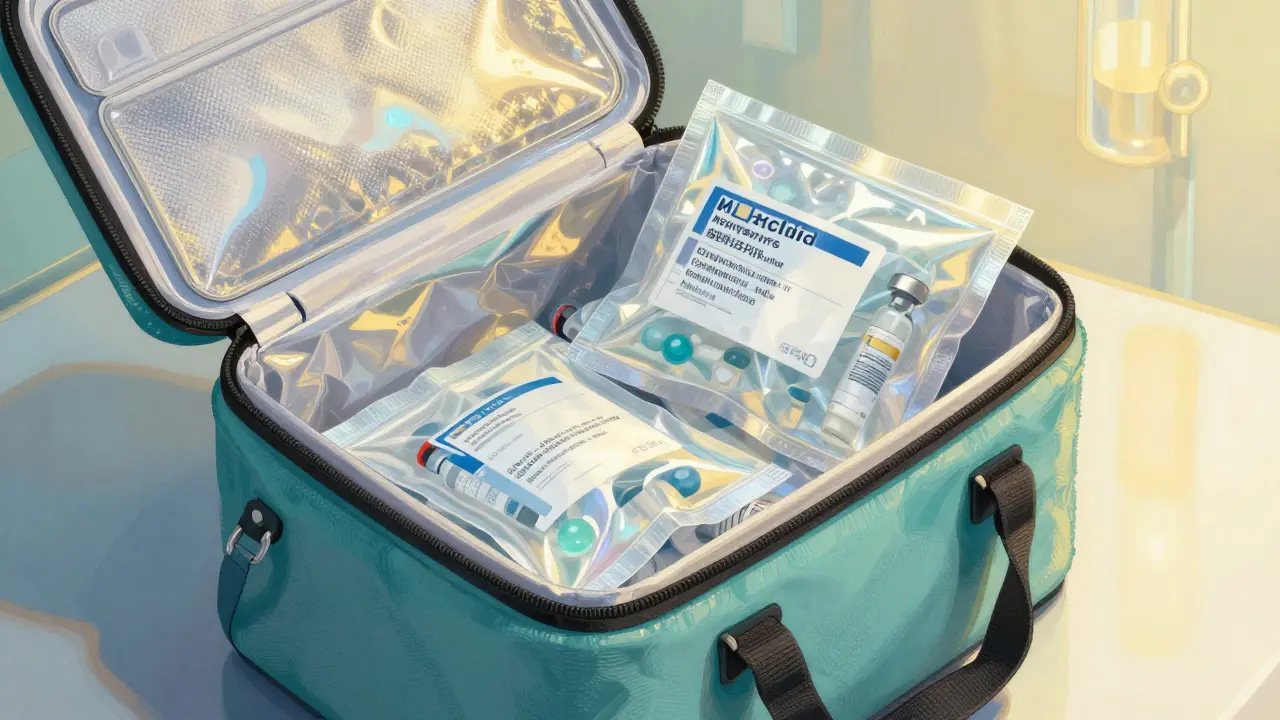
If you use insulin or other biologics, the cargo hold is your enemy. Temperatures in the belly of a plane can drop to -40°C (-40°F), which can cause irreversible crystallization in protein-based meds. Always keep these in your carry-on.
The International Society of Travel Medicine notes that biologics can lose about 5% of their potency every hour they spend above 25°C (77°F). To prevent this, use an insulated cooling bag. The TSA allows frozen gel packs or ice packs, but they must be completely frozen when you reach the security checkpoint. A good rule of thumb is to freeze your packs 24 hours before your trip; this typically keeps the medication at the required 2-8°C range for 12 to 18 hours.
Managing Needles, Syringes, and Pumps
Flying with injectables can feel stressful, but it's perfectly legal. The key is to keep your needles and syringes with the medication they are intended for. If you use an infusion pump, keep it on your person or in your carry-on.
One detail many people forget is disposal. Don't toss used needles into the seatback pocket or the airplane bathroom bin. Follow CDC (Centers for Disease Control and Prevention) guidelines by packing a portable sharps container. It's a small piece of equipment that prevents accidents for both you and the flight crew.
Navigating International Regulations
Crossing borders adds another layer of complexity. What's legal in Canberra or New York might be restricted elsewhere. For instance, the U.S. Department of State warns that countries like Japan, South Korea, and the UAE have strict rules about medications containing pseudoephedrine. In Japan, you might be limited to a 72-hour supply unless you have prior authorization.
Generally, EU countries are more lenient, often allowing 90-day supplies, whereas many Asian countries stick to a 30-day limit. If you're heading abroad, give yourself at least 14 days to get your documents translated if you're visiting a country where English isn't the primary language. A translated physician's letter is often the difference between a quick walk-through and a long interrogation at customs.

Pro Tips for a Stress-Free Journey
Timing is everything. If you're carrying complex medical equipment or large amounts of liquid meds, arrive at the airport earlier than usual-two hours for domestic and three for international. This gives you a buffer if you need to speak with a supervisor at the checkpoint.
Dealing with jet lag while managing a strict medication schedule is a challenge. The American Academy of Sleep Medicine recommends a gradual shift. If you're crossing five or more time zones, try shifting your dose time by 15 to 30 minutes every day for a few days before you leave. This eases your body into the new schedule and prevents massive gaps or overlaps in your treatment.
Can I put my medication in my checked luggage?
While you can, it is strongly discouraged. Checked bags are subject to extreme temperature swings (down to -40°C) and the risk of loss. If your luggage is delayed or lost, you lose your life-sustaining medication. Always pack your meds in your carry-on.
Do I need a doctor's note for my medication?
It's not always mandatory for basic pills in original bottles, but it is highly recommended. A doctor's letter on official letterhead detailing the medical necessity of your medication-especially for liquids, needles, or temperature-controlled drugs-can prevent delays and is often required for international customs.
What happens if my gel pack has melted a bit by security?
TSA rules state that gel packs must be frozen solid to pass through. If they have melted into a slushy state, they may be subject to additional screening or denied. Ensure you use a high-quality insulated bag and freeze your packs immediately before leaving for the airport.
Are there limits on how much liquid medication I can bring?
There is no official "hard limit" for medically necessary liquids, but the FAA suggests that quantities over 2,000 mL (about 67 ounces) may require special approval. For most people, bringing a reasonable supply for the duration of the trip is perfectly fine as long as it's declared.
Can I use a digital prescription or a photo of my label?
Digital copies are great for backup, but TSA generally requires the physical label on the original container. Some airlines and airports are starting to use digital medication passports, but until that is universal, stick to the physical labels to avoid issues.
Next Steps for Your Trip
If you're planning a trip in the next few weeks, start by auditing your supply. Check expiration dates and request refills early so you aren't rushing at the last minute. If you use a biologic, test your cooling bag for 24 hours at home to make sure it actually maintains the 2-8°C range.
For those traveling internationally, check the embassy website of your destination country specifically for "restricted medicines." If you find your medication is on the list, contact your doctor immediately to get the required authorization forms. Finally, set a calendar reminder to start your time-zone adjustment shifts 3-5 days before departure.