
Imagine paying $500 for a monthly prescription, only to find out that a few months later, the exact same medication is available for $20. This isn't a pricing error; it's the result of generic drug competition. When a pharmaceutical company develops a new drug, they get a patent that gives them a monopoly for several years. But once that patent expires, the floodgates open. The more companies that enter the fray to produce that same drug, the lower the price drops for everyone. It's a classic supply-and-demand battle where the patient finally wins.
| Number of Generic Competitors | Average Price Reduction | Market Dynamic |
|---|---|---|
| 1 Manufacturer | ~0% to 17% | Limited impact; near-monopoly |
| 2 Manufacturers | ~39.5% | Noticeable price drops begin |
| 3 Manufacturers | ~52.5% | Significant price erosion |
| 4+ Manufacturers | ~70.2% or more | Deep discounts; commodity pricing |
The Engine Behind Cheap Meds: The Hatch-Waxman Act
You can't talk about generic drugs without mentioning the Hatch-Waxman Act is a 1984 US law that created the legal framework for generic drug approval while protecting the incentives for original innovators. Before this act, generic companies had to conduct their own massive, expensive clinical trials to prove a drug worked-essentially repeating the original company's work. Hatch-Waxman changed the game by allowing generics to prove "bioequivalence." Basically, they just have to show their version does the same thing in the body as the brand-name version. This lowered the barrier to entry, allowing dozens of manufacturers to jump in as soon as a patent lapsed.
This regulatory shift created a massive financial ripple effect. The FDA (Food and Drug Administration) has noted that these competitive forces saved the U.S. healthcare system a staggering $1.7 trillion over the decade ending in 2019. When you have five or ten companies fighting for the same customer, the only way to win is usually to offer a lower price.
Why Some Drugs Stay Expensive While Others Plummet
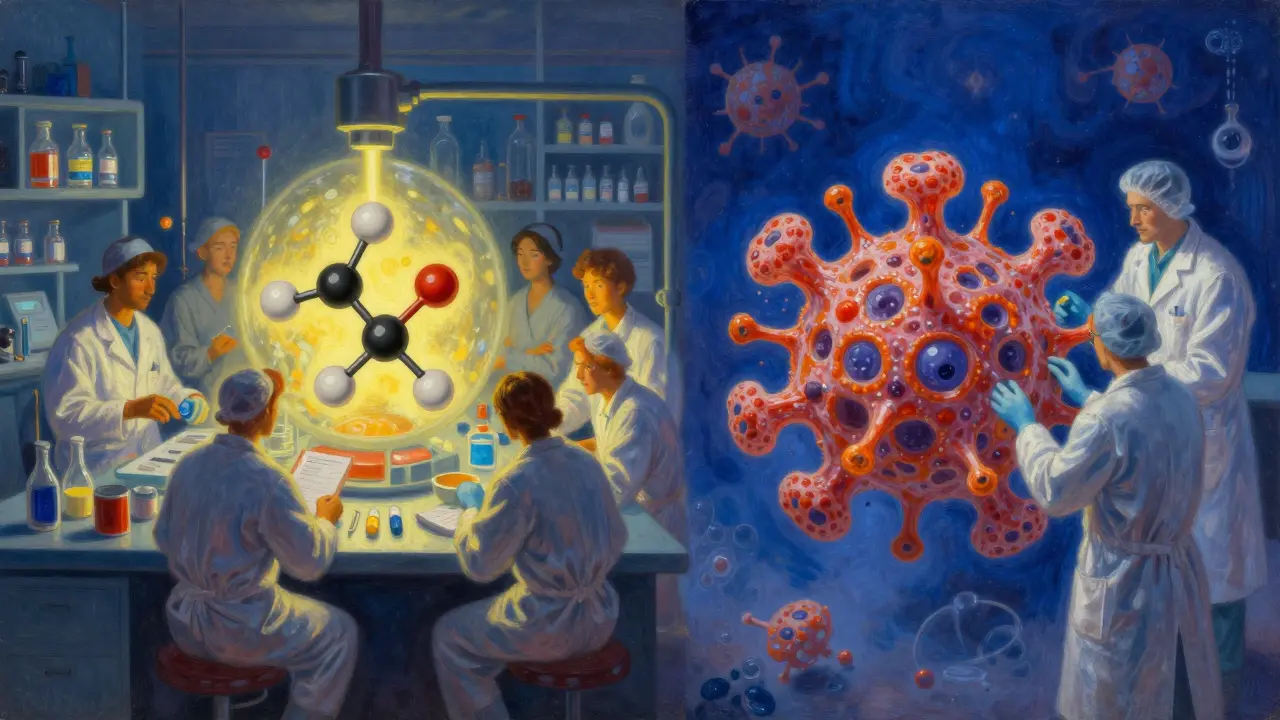
Not all drugs are created equal. If you're taking a simple pill, like Metformin for diabetes, you've probably noticed it's incredibly cheap. That's because it's a small-molecule drug. These are relatively easy to replicate, leading to robust competition from at least eight different manufacturers. In these markets, prices often stabilize below $10 for a 90-day supply because there is simply too much competition for any one company to keep prices high.
Now, contrast that with Biosimilars. These are the "generics" of complex biologic drugs (which are grown in living cells rather than chemically synthesized). They are far harder to make. Because the manufacturing process is so complex, you don't see ten competitors jumping in. Instead, you see one or two. A study in JAMA Network Open found that because biosimilars don't have the same level of competition as oral generics, spending on biologics remained significantly higher than it would have if the market were more open.
The Danger of the "Generic Monopoly"
Here is the scary part: competition can vanish. We've seen a trend where smaller generic firms merge into larger ones. When this happens, the number of players in the market shrinks. Research from the NBER suggests that over 50% of generic drugs now have only two competitors, and 40% have just one. When a market consolidates, the "race to the bottom" on pricing stops.
We see this play out in real-time on forums like r/pharmacy. Patients often report sudden price spikes of 300% to 500% for certain medications. For example, the antiepileptic drug Levetiracetam saw price jumps after the number of manufacturers dropped from five down to two. When only one or two companies make a drug, they have no incentive to lower prices, and if one factory has a quality issue, there's no backup, leading to dangerous shortages.
How to Navigate the Generic Market as a Patient
If you want to take advantage of these price drops, you need to understand how the system works at the pharmacy counter. Most states have "pharmacy substitution laws" that allow your pharmacist to swap a brand-name drug for a generic one automatically, unless your doctor specifically writes "do not substitute."
To ensure you're getting the best deal, keep these tips in mind:
- Check the Orange Book: This is the FDA's official list. Look for an "AB" rating, which means the generic is therapeutically equivalent to the brand.
- Ask about "Therapeutic Interchange": Sometimes a pharmacist can suggest a different generic in the same class that is significantly cheaper.
- Use Aggregators: Tools like GoodRx track the pricing across thousands of pharmacies, showing you exactly where the competition is driving prices the lowest.
The Role of PBMs and the Future of Pricing
It's not just about who makes the drug; it's about who buys it. Pharmacy Benefit Managers (PBMs) act as the middlemen. They negotiate prices on behalf of insurance companies. While they've been criticized for lack of transparency, their massive purchasing power can actually force generic manufacturers to keep prices low, even when there are only a few players in the market.
Looking ahead, the FDA is trying to fix the consolidation problem with the Drug Competition Action Plan and the CREATES Act. These are designed to stop brand-name companies from blocking generic competitors from getting the samples they need to prove equivalence. The goal is to ensure that the "generic cliff"-the moment a patent expires-actually leads to the price drops we expect.
Does a generic drug work as well as a brand-name drug?
Yes. For a generic to be approved, the FDA requires it to be bioequivalent to the brand-name drug. This means it has the same active ingredient, strength, dosage form, and route of administration, and it performs the same way in the body.
Why is my generic medication suddenly more expensive?
This usually happens due to market consolidation. If several manufacturers stop producing a drug because it's no longer profitable, the remaining one or two companies can raise prices without fear of losing customers to a cheaper competitor.
What is the difference between a generic and a biosimilar?
Generics are copies of chemically synthesized drugs (small molecules). Biosimilars are copies of biologics, which are made from living organisms. Because biologics are so complex, biosimilars aren't identical copies but are "highly similar" and have no clinically meaningful differences in safety or effectiveness.
How many competitors are needed to really lower the price?
While one competitor starts the process, the most dramatic drops happen between the first and third entrant. Once you hit four or more competitors, prices typically plummet by 70% or more compared to the original brand price.
Can I ask my doctor for a generic version?
Absolutely. Most doctors are happy to prescribe generics to save you money. You can specifically ask if a "therapeutically equivalent" generic exists for your medication to ensure you get the most cost-effective option.