
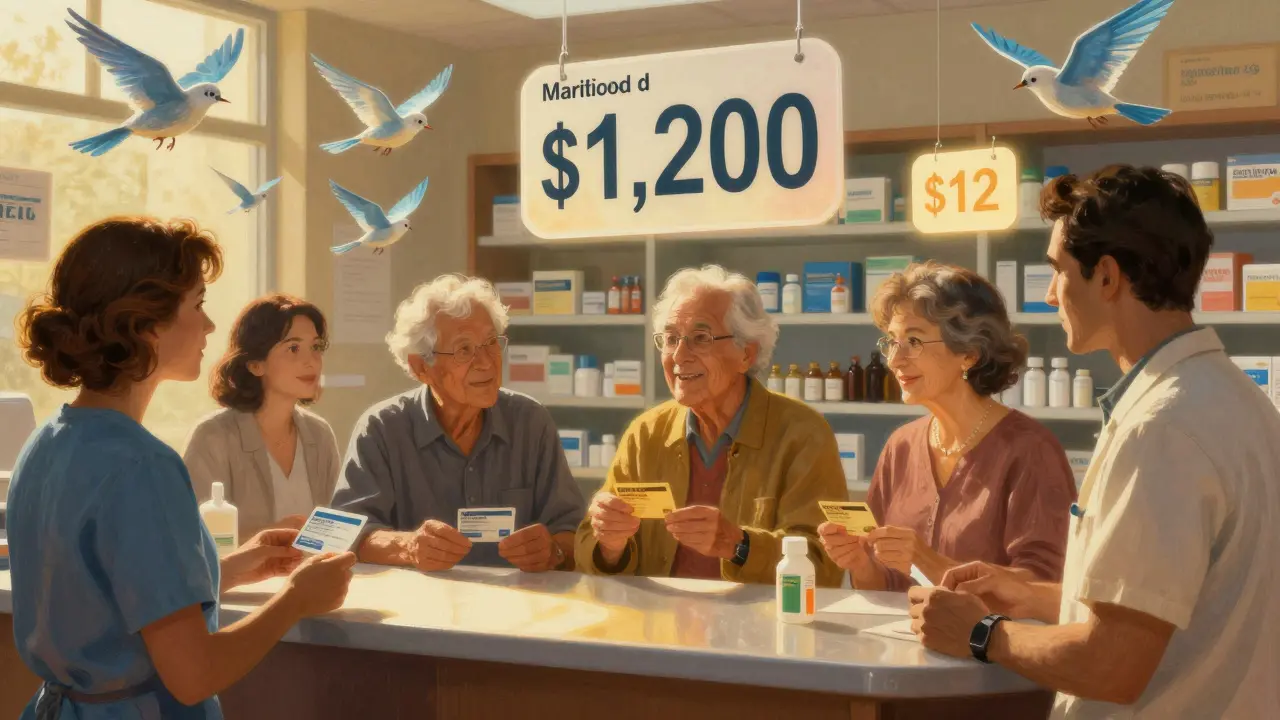
Buying prescription drugs shouldn’t feel like a financial gamble. Yet for millions of Americans, a simple 30-day supply of medication can cost more than a grocery run - especially if you’re uninsured, underinsured, or stuck with a high-deductible plan. That’s where prescription discount programs and coupons come in. They promise big savings, flashy apps, and instant relief. But do they really work? Or are they just a distraction from deeper problems in how drugs are priced?
How These Programs Actually Work
There are three main types of prescription savings tools you’ll run into: manufacturer coupons, third-party discount cards, and prescription assistance programs (PAPs). Each has its own rules, limits, and hidden catches.Manufacturer coupons are handed out by drug companies - usually for brand-name medications. They’re often found on TV ads or in doctor’s offices. These aren’t discounts in the traditional sense. Instead, they’re rebates: you pay the full price at the pharmacy, then the drugmaker gives you money back. The catch? They only work if you have insurance that doesn’t allow stacking. And if you’re on Medicare Part D, using these coupons can actually hurt you - they don’t count toward your deductible or out-of-pocket maximum, meaning you stay in the coverage gap longer.
Third-party discount cards like GoodRx, Blink Health, and SingleCare are different. These companies negotiate cash prices directly with pharmacies. You don’t need insurance. You just show the card or app code at the counter. For generics, the savings can be huge. A 90-day supply of metformin might cost $12 with GoodRx, while your insurance copay is $45. That’s not a fluke. In 2022, a study found these cards cut generic drug prices by an average of 65%. For some meds, like lisinopril or atorvastatin, you could save over $40 per prescription.
Prescription assistance programs (PAPs) are run by nonprofits, clinics, or drugmakers for people with very low income or no insurance. These aren’t coupons - they’re free medications. A free clinic in Tennessee helped 61 patients get 23 different drugs over 13 months, saving them a total of $222,563. That’s nearly $3,650 per person. But getting into these programs isn’t easy. You need paperwork - tax returns, pay stubs, doctor letters. It takes time. But if you qualify, it’s the most reliable way to get meds without paying a dime.
When They Work - And When They Don’t
The biggest factor in whether a discount program saves you money? What drug you’re taking.For generics? These programs are often game-changers. A 2022 analysis showed that a 4-drug heart failure regimen for a generic combo (like lisinopril, metoprolol, furosemide, and spironolactone) dropped from $52.80 to $18.60 with a discount card. That’s a 65% drop. In real life, people on Reddit report saving $30-$50 on common meds like metformin, levothyroxine, or simvastatin. One user saved $47.83 on a 90-day supply of metformin - more than his insurance copay.
But for brand-name drugs? Forget it. The same heart failure regimen, if all brand-name, dropped from $1,300.50 to $1,212.46 with a coupon. That’s a savings of $88 - less than 7%. And that’s the best-case scenario. Many brand-name coupons only reduce your copay to $10 or $20 - but your insurance still pays the full list price, which can be $1,000+ per month. You’re not saving money overall. You’re just shifting the cost to your insurer - and eventually, to everyone else through higher premiums.
Here’s the kicker: research from JAMA Network Open found that when people use manufacturer coupons for brand-name drugs, they’re 60% more likely to stick with the expensive version instead of switching to a cheaper generic - even when the generic works just as well. That’s not helping your wallet. It’s helping drug companies keep prices high.
Medicare Part D users face another trap. Federal rules ban using manufacturer coupons with Medicare Part D unless you get special approval. Even then, the coupon doesn’t count toward your out-of-pocket limit. So you might pay $10 for a drug today, but you’re still stuck in the donut hole next month. Meanwhile, discount cards like GoodRx can sometimes be cheaper than your Medicare copay - but only if you pay cash and skip insurance entirely. That’s confusing, and many seniors don’t know how to navigate it.
Real People, Real Savings (and Real Frustrations)
User experiences vary wildly. On Trustpilot, GoodRx has a 4.3/5 rating. People love the app. They love the simplicity. They love saving $30 on their cholesterol pill.But here’s what nobody talks about: inconsistency. One user on Consumer Affairs said they showed a GoodRx coupon at three different pharmacies - and got three different prices. One charged $15. Another charged $42. Another refused the coupon entirely. Pharmacists aren’t always trained on these programs. Some don’t know how to process them. Others say, “We can’t accept that.” You end up wasting time, driving around, and still paying full price.
Another common complaint: minimal savings on brand-name drugs. One person with chronic pain used a coupon for Lyrica - a $500-per-month drug - and saved $1.20. That’s not a discount. That’s a joke.
And then there’s the confusion factor. A Medicare Rights Center survey found that 42% of seniors using discount cards didn’t know whether to use the card or their insurance. That’s not user error. That’s a broken system.
Who Benefits the Most?
The real winners? People without insurance, people with high-deductible plans, and people taking generics.According to Blue Cross Blue Shield, 54% of members who stopped filling prescriptions because of cost later used discount cards to get their meds. Average savings? $18.75 per prescription. That’s life-changing for someone choosing between insulin and rent.
But here’s the uncomfortable truth: the biggest beneficiaries of manufacturer coupons aren’t patients. They’re drug companies. A 2024 study showed coupon use is tied to market competition - not patient need. When a drug has few competitors, companies offer bigger coupons to lock people in. When generics are available, they rarely offer coupons at all. That’s not generosity. That’s strategy.
Meanwhile, the Congressional Budget Office estimates these coupons could raise Medicare Part D spending by $2.7 billion a year - because people stay on expensive drugs longer. That’s money pulled from the program that could go to lowering prices for everyone.
What Should You Do?
If you’re paying out of pocket for meds, here’s your step-by-step plan:- Check your insurance copay first. Write it down.
- Go to GoodRx or SingleCare. Enter your drug name and zip code. Compare cash prices.
- If the discount card price is lower than your copay, pay cash. Skip insurance.
- If you’re on Medicare Part D, don’t use manufacturer coupons unless your plan allows it - and even then, check if it helps your out-of-pocket total.
- For brand-name drugs, ask your doctor: “Is there a generic alternative?” If yes, request it.
- If you can’t afford your meds, search NeedyMeds.org. It lists free or low-cost PAPs by drug name and income level.
- Call your pharmacy and ask: “Can you match this cash price?” Many will.
Don’t assume the coupon is the best deal. Always compare. Always ask. Always check.
The Bigger Picture
Discount programs aren’t the solution to high drug prices. They’re a Band-Aid on a broken system. They help people survive - but they don’t fix the problem.The Inflation Reduction Act, starting in 2025, will cap Medicare Part D out-of-pocket costs at $2,000 a year. That’s huge. It means fewer people will need coupons just to get their insulin. Drugmakers are already pushing back. They don’t want to lower prices. They want to keep selling expensive pills with coupons as a marketing tool.
The future? The most sustainable programs will be the ones built into insurance - not outside it. Imagine an app that automatically compares your insurance copay with cash prices and picks the cheaper one. That’s already being piloted by 12 major pharmacy chains. That’s the real innovation.
Until then, use discount cards smartly. Know your meds. Know your options. And never assume a coupon means savings - unless you’ve checked the math yourself.
Do prescription discount coupons work with Medicare Part D?
Most manufacturer coupons cannot be used with Medicare Part D unless you get special approval from your plan. Even then, the discount doesn’t count toward your out-of-pocket maximum, which means you stay in the coverage gap longer. Third-party discount cards like GoodRx can sometimes be cheaper than your Medicare copay - but only if you pay cash and don’t use your insurance at all.
Are GoodRx and other discount cards free to use?
Yes. GoodRx, SingleCare, and Blink Health are free to use. You don’t need to sign up, pay a fee, or provide personal information. You just search for your drug, pick the lowest price, and show the code at the pharmacy. They make money by charging pharmacies a small fee when you use their card.
Can I use a coupon for a brand-name drug and still save money?
Sometimes - but rarely. Manufacturer coupons for brand-name drugs usually only reduce your copay to $10 or $20. But the drug’s full price might still be $1,000+. Your insurance pays the rest, and you’re not saving overall. If you can switch to a generic version, you’ll save far more - often over $100 per prescription.
Why is the price different at every pharmacy?
Pharmacies set their own cash prices independently. Discount card companies negotiate deals with each one, so prices vary wildly. A drug might cost $12 at Walmart, $45 at CVS, and $20 at Walgreens - all for the same coupon. Always check multiple locations before you go.
What if I can’t afford my meds even with a discount card?
Check NeedyMeds.org. It’s a free database of Prescription Assistance Programs (PAPs) run by nonprofits and drugmakers. These programs give free or low-cost medications to people with low income or no insurance. You’ll need to fill out an application and provide proof of income, but if you qualify, you can get your meds for free - no strings attached.


