

When you start a biologic therapy, you’re not just getting a new drug-you’re taking on a new daily responsibility. These treatments, used for conditions like rheumatoid arthritis, psoriasis, and Crohn’s disease, come in pre-filled pens or syringes you inject yourself. Sounds simple, right? But biologic therapy injection isn’t like taking a pill. One wrong move can lead to infection, missed doses, or even stopping treatment altogether. And the truth is, most people aren’t trained well enough to do it safely.
What You’re Really Being Asked to Do
Biologic therapies are made from living cells, not chemicals. That makes them powerful-but also fragile. They must stay sterile. A tiny bit of dirt, a shaky hand, or a reused needle can turn a lifesaving treatment into a source of infection. The CDC says improper injection technique causes 12.7% of all outpatient skin infections linked to injectable meds. For people on biologics, that risk is even higher because these drugs suppress your immune system. A small red spot on your skin might look harmless, but it could be the start of something serious.Training Isn’t Just a One-Time Show
Most clinics give you a 30-minute demo. A nurse shows you how to load the pen. You press the button once. They say, "You got it." Then you go home with six months of medication and no follow-up. That’s not training. That’s a gamble. Research shows effective training has three parts: tell, show, and do. You need to hear the steps, see them done, then practice them yourself-over and over. But only 27% of patients get all three. Most get one or two. And in a 2022 study, 11.5% of patients got zero training at all, even though they’d never injected anything before. The problem isn’t that providers don’t care. It’s that they’re rushed. Nurses and doctors have 30 minutes total for training, but experts say you need 90 to 120 minutes spread across multiple sessions. That’s not happening. So patients are left guessing.The Hidden Danger: Anxiety and Routine
It’s not just about the needle. It’s about fear. One patient on Reddit said: "They showed me once, had me do it once, and sent me home with six months of medication-no follow-up." That’s the norm. And it’s dangerous. Anxiety makes your hands shake. It makes you rush. It makes you skip steps. In fact, 68% of injection errors happen during the first 10 times you do it at home. Why? Because you’re tired. You’re distracted. You’re stressed. You forgot to wash your hands. You didn’t rotate your injection site. You didn’t wait for the alcohol to dry. The good news? Rituals work. Patients who built a routine-same time, same spot, same order of steps-were far more likely to stick with treatment. One study found 77.8% of successful patients had a ritual. It might be as simple as: "After I brush my teeth, I lay out my supplies, wash my hands for 20 seconds, pick my site, and inject." That routine cuts anxiety. And anxiety cuts infection risk.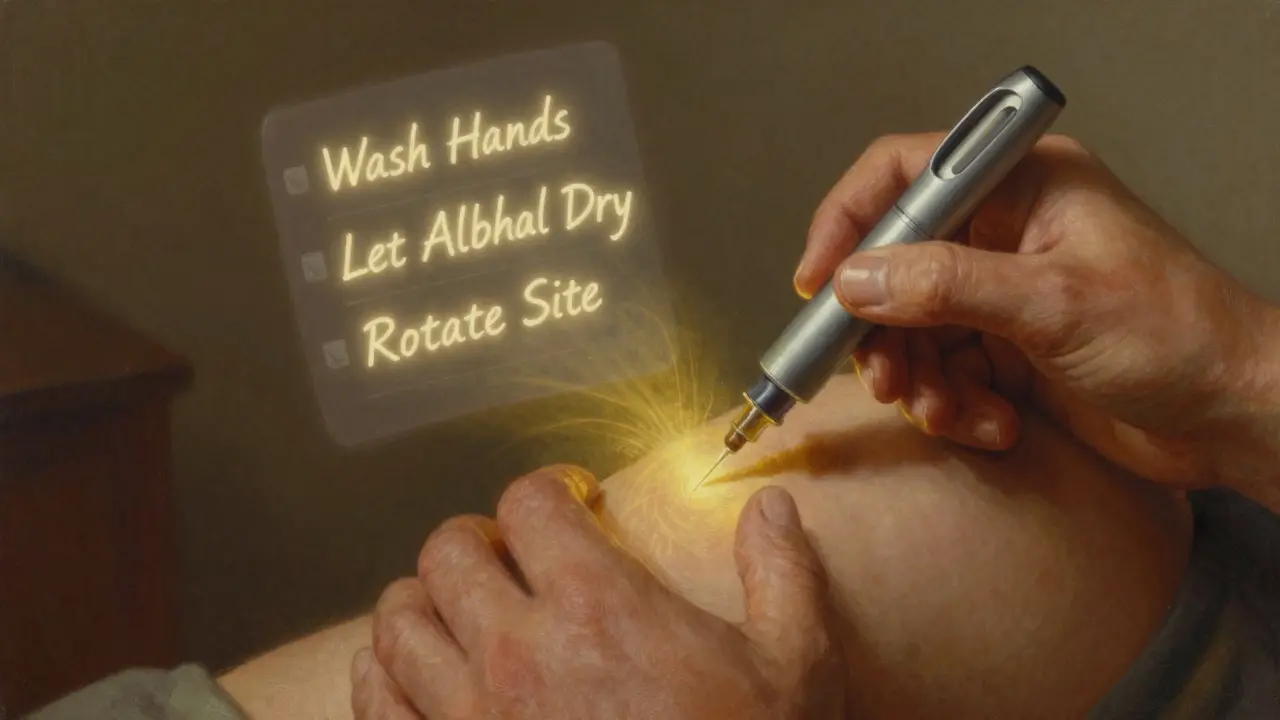
How to Avoid Infection
Infection doesn’t always mean an abscess. Sometimes it’s just redness. Swelling. Warmth. A fever. The CDC says any red area larger than 2 cm or a temperature above 100.4°F (38°C) after injection is a red flag. Don’t wait. Call your doctor. Here’s what actually works:- Wash hands for 20 seconds-sing "Happy Birthday" twice. No shortcuts.
- Let alcohol dry-don’t wipe or fan it. Wait until it’s gone. Wet alcohol pushes germs into your skin.
- Rotate sites-use your thigh, abdomen, or upper arm. Keep injections at least one inch apart. Don’t reuse the same spot.
- Use the right device-modern pens hide the needle. That’s good. But you still need to press firmly and hold for 10 seconds after clicking.
- Dispose safely-use a sharps container. Never toss needles in the trash.
What Training Should Look Like
Real training isn’t a demo. It’s practice. And it’s repeated. Studies show patients who got three or more supervised practice sessions retained 94% of their technique six months later. Those with only one session? Only 52%. That’s a huge gap. Effective training includes:- Hands-on practice with a training device (no needle, no medicine-just feel and weight).
- Teach-back: "Show me how you’d do it." If you can’t explain it, you won’t do it right.
- Video resources you can watch again later.
- A follow-up call or video check-in after your first week.
- Discussion about anxiety-what to do if you panic, if you feel dizzy, if you drop the pen.

What’s Changing
The FDA just released new draft guidelines in March 2023 demanding consistent, structured training for all self-injected biologics. That’s a big deal. And some companies are stepping up. Adbry, for example, now offers a digital portal with video demos, virtual coaching, and injection trackers. Patients can log each shot, see reminders, and watch replays of proper technique. The most promising innovation? "Ritual training." Teaching patients to create a personal routine-not just a checklist, but a calming ritual-reduced anxiety-related errors by 53%. It also improved adherence by 41% over six months. That’s not just better technique. That’s better health.What You Should Ask Your Provider
Don’t wait until you’re scared. Ask these questions before your first injection:- "Will I get to practice with a training device?"
- "Can I do this more than once?"
- "Will I get a video or written guide to take home?"
- "Who can I call if I’m stuck or scared after I leave?"
- "Can we go over infection signs-what redness, swelling, or fever means?"
Final Reality Check
Biologic therapies can change your life. But they only work if you use them safely. And safe use isn’t about being brave. It’s about being prepared. You don’t need to be a nurse. You just need to know the steps, practice them, and build a habit. Infection isn’t inevitable. It’s preventable. But only if you’re trained-not just shown.Can I reuse a needle for biologic injections?
Never reuse a needle. Biologic pens use single-use needles. Reusing them dulls the tip, increases pain, and raises infection risk. Even if the needle looks clean, microscopic bacteria can remain. Always use a new needle for every injection.
What if I miss an injection?
Don’t double up next time. Check your medication guide. Most biologics allow you to take the missed dose within a 1-3 day window. If it’s been longer, skip it and resume your regular schedule. Never take two doses at once. If you’re unsure, call your doctor or pharmacist.
Is it normal to feel a burning sensation during injection?
A slight sting is normal, especially if the skin isn’t dry after alcohol. A burning or sharp pain that lasts more than a few seconds could mean you hit a nerve or injected too fast. Pause, breathe, and try again slowly. If it keeps happening, ask your provider about injection technique or site rotation.
How do I know if my injection site is infected?
Signs include redness larger than 2 cm, warmth, swelling, pus, or a fever over 100.4°F (38°C). If you notice any of these, contact your doctor immediately. Don’t wait. Biologics weaken your immune system, so infections can spread fast. Early treatment is key.
Can I inject in the same spot twice in a row?
No. Always rotate sites. Injecting in the same spot too often can damage tissue, cause lumps under the skin (lipohypertrophy), and increase infection risk. Keep injections at least one inch apart. Use a chart or app to track where you’ve injected.


