

Imagine your liver quietly struggling while you go about your day. Millions of people walk around with fat building up in their livers without knowing it until a routine blood test shows a spike in liver enzymes. This condition used to be called Non-Alcoholic Fatty Liver Disease (NAFLD), but you might hear doctors calling it something different now.
The big question isn't just about having fat in your liver; it is whether that fat is hurting your liver cells. That distinction separates simple fatty liver (NAFL) from a more serious condition known as Non-Alcoholic Steatohepatitis (NASH). If you have been told you have 'fatty liver,' understanding exactly where you sit on this spectrum can mean the difference between watching your numbers and needing aggressive intervention to prevent cirrhosis.
This guide breaks down exactly what these terms mean, how they differ, and most importantly, why the presence of scarring (fibrosis) is the single biggest predictor of your long-term health.
The Core Difference: Simple Fat vs. Active Damage
Non-Alcoholic Fatty Liver Disease (NAFLD) is an umbrella term. It describes any amount of excess fat stored in the liver cells when there is no other cause like alcohol. Originally, the name focused on what wasn't happening-no heavy drinking-but modern medicine has realized the real issue lies in metabolism.Think of NAFLD as a bucket that holds two very different scenarios.
Scenario A is simple steatosis (often called NAFL). Your liver cells are stuffed with fat droplets, usually because your body is storing energy differently due to insulin resistance or obesity. However, the cells are not dying, and there is no active inflammation. Many people live decades with this stable form without severe consequences.
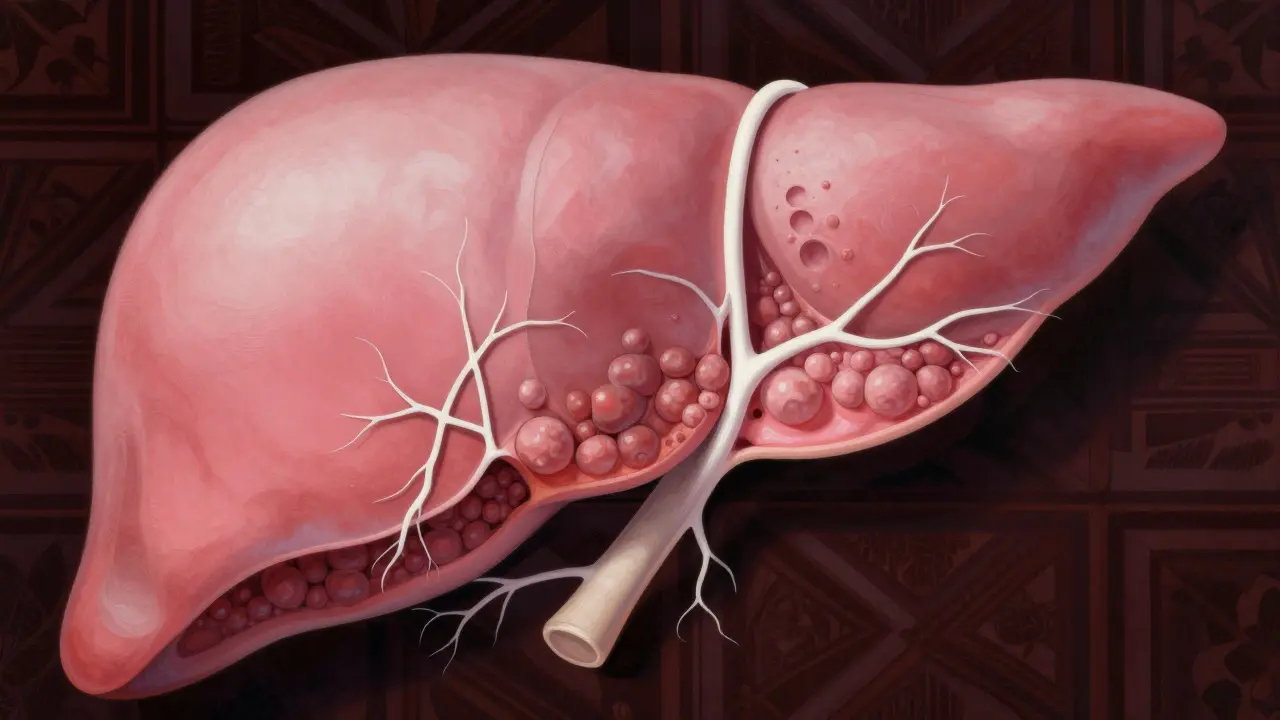
Scenario B is Non-Alcoholic Steatohepatitis (NASH). This occurs when the fat accumulation triggers an immune response. Here, the fat isn't just sitting there. It causes stress inside the liver cell, leading to injury, swelling (ballooning), and inflammation. This is the tipping point. While NASH affects roughly 20% of those with fatty liver, it carries the risk of progressing rapidly to permanent scarring.
The critical takeaway here is histology. Without looking at a tissue sample under a microscope, it is incredibly difficult to tell Scenario A from Scenario B just by looking at a belly or checking a standard cholesterol panel.
| Feature | Simple Steatosis (NAFL) | NASH |
|---|---|---|
| Steatosis (Fat) | Present (>5%) | Present (>5%) |
| Inflammation | Absent | Present |
| Cell Injury | No | Yes (Ballooning) |
| Fibrosis Risk | Low | High |
| Progression Rate | Minimal over years | 20-40% develop cirrhosis in 20yrs |
The Silent Threat: Understanding Fibrosis Stages
If you were told you have NASH, the next thing your doctor needs to know is the stage of your fibrosis. Fibrosis is the formation of scar tissue. When your liver heals from the inflammation caused by fat, it lays down collagen scars. Eventually, too much scar tissue blocks blood flow and function.
Doctors use a 0-to-4 scale to grade this damage. Knowing your stage helps determine if you are a candidate for medication or just lifestyle changes.
- Stage 0: No fibrosis. Even if you have NASH, if you don't have scars yet, you are in a window where reversal is highly possible.
- Stage 1: Mild perisinusoidal fibrosis. Small amounts of scarring around the vessels supplying liver cells.
- Stage 2: Moderate fibrosis. Scarring is spreading to the portal areas of the liver lobes.
- Stage 3: Bridging fibrosis. This is significant. Scar bands are connecting different parts of the liver lobes, creating early pressure problems.
- Stage 4: Cirrhosis. The liver is hard and nodular. This is irreversible, though we can still manage complications.
Research published in the journal Hepatology tracked over 1,200 patients. They found that among those with NASH, nearly half developed significant fibrosis over 15 years, whereas less than 13% of simple fatty liver patients did. However, once you hit Stage 3, the odds of liver-related mortality jump significantly. This is why staging is the priority for every specialist.
New Terminology: Why MASLD Matters
You may notice a shift in language in your patient records. In June 2023, major international groups like the American Association for the Study of Liver Diseases (AASLD) and the European Association for the Study of the Liver (EASL) voted to rename the condition. They replaced NAFLD with Metabolic Dysfunction-Associated Steatotic Liver Disease (MASLD).
Metabolic Dysfunction-Associated Steatotic Liver Disease (MASLD) The new preferred term that acknowledges metabolic syndrome as the driver rather than absence of alcohol. This update was driven by a few key reasons:- It removes the stigma associated with "non-alcoholic" labels, as many healthy non-drinkers were confused by the old name.
- It explicitly ties the diagnosis to metabolic criteria like waist circumference, triglycerides, and glucose levels.
- It allows for better research funding and clinical trial inclusion.
So, if your doctor says you have MASLD or Metabolic Dysfunction-Associated Steatohepatitis (MASH), they are describing the exact same physiological reality as the older NAFLD and NASH terms, just with more precision regarding the cause.
How We Diagnose the Severity
Determining if you have simple fat or dangerous steatohepatis often requires a detective's approach. A standard ultrasound is cheap and quick, but it cannot reliably tell you how much scarring you have. Ultrasound is great for seeing if fat exists, but it fails when trying to distinguish early-stage inflammation.
The gold standard remains a liver biopsy. It gives the pathologist a direct look at the cellular architecture to spot ballooning hepatocytes. However, biopsies carry risks-bleeding or pain-and are invasive. Because of this, doctors rely heavily on non-invasive scores first.
FIB-4 Score: This is calculated using your age and blood work results (platelets, AST, ALT). If your score is above 1.3, it raises suspicion for advanced fibrosis. It's a powerful triage tool available in almost every clinic.
FibroScan (VCTE): This device sends sound waves through the liver to measure stiffness. A reading higher than 8.2 kPa usually suggests significant fibrosis. Not all clinics have one, but if yours does, it's a massive advantage over guessing.
MRI-PDFF: For precise measurement of fat content, magnetic resonance imaging is superior. It quantifies the fat fraction percentage, ensuring we aren't missing mild cases.
Even with these tools, errors happen. Dr. Elizabeth Carey from Mayo Clinic noted that up to 30% of presumed NASH cases based solely on non-invasive testing might not show actual liver damage upon biopsy. This reinforces the need for careful interpretation of these numbers rather than treating them as absolute proof.
Risk Factors and Acceleration
Why do some people with fat in their liver progress to cirrhosis while others remain stable? Genetics play a role, specifically variations in genes like PNPLA3, but lifestyle factors are often the accelerant.
Type 2 diabetes is the strongest driver. About 60% to 70% of patients who progress to NASH or cirrhosis have diabetes. High insulin levels drive fat storage in the liver and trigger the inflammatory cascade. Blood pressure control is equally vital; hypertension correlates strongly with faster fibrosis.
Sleep Apnea is another often overlooked factor. Around half of NASH patients suffer from obstructive sleep apnea. The intermittent lack of oxygen (hypoxia) during sleep damages the gut lining, allowing toxins to enter the bloodstream and inflame the liver further.
If you check your profile and see a BMI over 30, plus high triglycerides and low HDL, you are in the highest risk category. Losing weight is not just cosmetic advice-it is the primary mechanism to reverse the biological process damaging your organ.

Treatment: Beyond Diet Alone
For a long time, doctors could only offer "lifestyle modification." That meant diet and exercise. But science finally broke through recently. As of 2023, the FDA approved the drug Resmetirom (brand name Rezdiffra) specifically for patients with moderate to advanced fibrosis. This milestone changed the landscape from pure observation to targeted therapy.
However, medication works best as a partner to weight loss. Clinical trials consistently show that losing 7% to 10% of your total body weight creates the magic threshold. At this level, NASH can resolve, meaning inflammation clears up, and fibrosis can actually regresses. In a study tracking patients over five years, those who achieved this weight loss saw a 90% regression rate from NASH back to simple steatosis.
Glucagon-like peptide-1 (GLP-1) receptor agonists, often used for diabetes, also show promise. Drugs like semaglutide help reduce liver fat content significantly. Since metabolic dysfunction drives the disease, fixing the metabolic engine is the logical path forward.
Frequently Asked Questions
Can fatty liver be reversed?
Yes. Early-stage fatty liver (steatosis) is fully reversible through weight loss and diet. Even NASH can regress to simple fatty liver if fibrosis hasn't reached the cirrhosis stage. Weight loss of 7-10% is typically required to achieve this reversal.
What is the main difference between NAFL and NASH?
NAFL is simple fat accumulation without cell damage or inflammation. NASH includes fat accumulation plus active inflammation and liver cell injury, which puts you at risk for scarring (fibrosis).
Is NAFLD the same as MASLD?
They refer to the same underlying condition, but MASLD is the newer, preferred terminology adopted in 2023 to emphasize the metabolic nature of the disease rather than just excluding alcohol consumption.
Do I need a biopsy to know my stage?
Ideally, a biopsy is the gold standard. However, doctors often use non-invasive scores like FIB-4 or a FibroScan elastography test first. A biopsy is recommended if these scores suggest high risk of advanced fibrosis.
What medications are available for fatty liver in 2026?
Resmetirom is FDA-approved for moderate-to-advanced fibrosis. Other agents like GLP-1 agonists are commonly prescribed off-label or for co-morbidities like diabetes, showing positive effects on liver fat.


