

When you pick up a generic pill at the pharmacy, you assume it works just like the brand-name version. That’s the whole point of bioequivalence - it’s the legal and scientific guarantee that the generic delivers the same medicine, the same way, to your body. But what if the batch of generic pills you’re holding isn’t even close to the batch used in the bioequivalence study? What if the brand-name drug itself varies from batch to batch, and no one’s checking?
What Bioequivalence Actually Measures
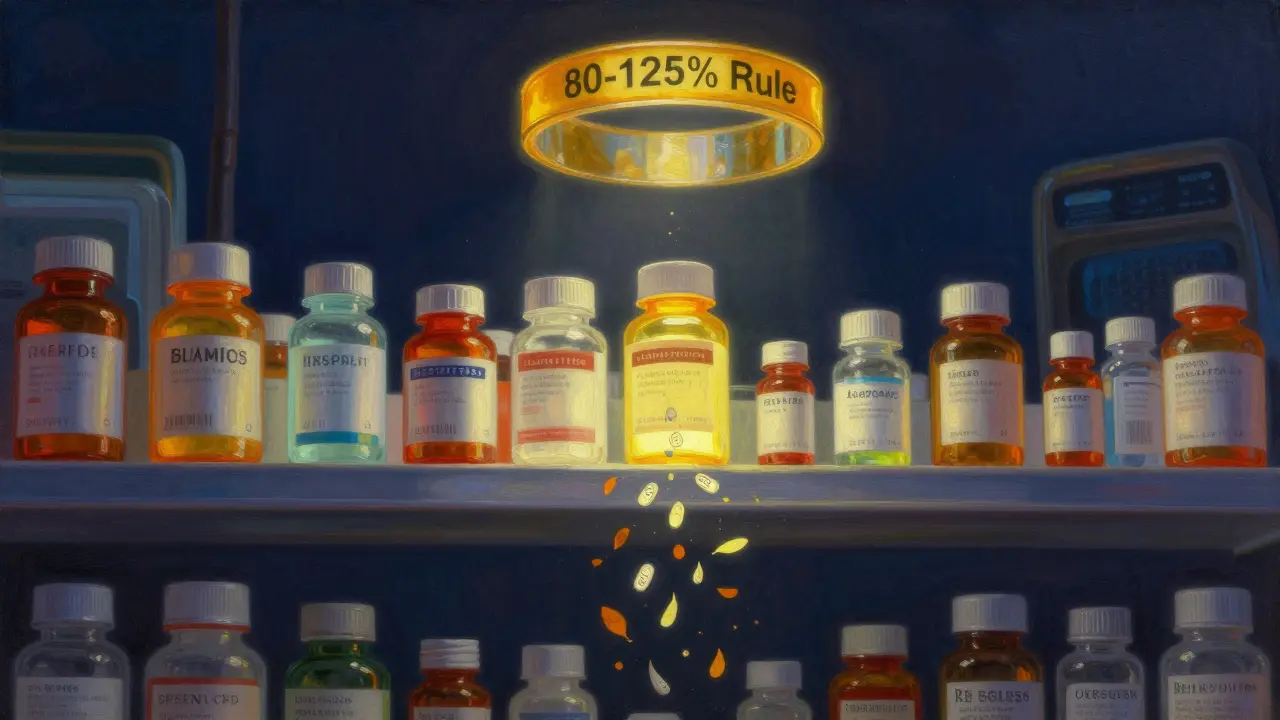
Bioequivalence isn’t about whether two drugs look the same or cost the same. It’s about whether they deliver the same amount of active ingredient into your bloodstream at the same speed. That’s measured using two key numbers: AUC (how much drug gets absorbed over time) and Cmax (how high the peak concentration goes). Regulatory agencies like the FDA and EMA say a generic is bioequivalent if the 90% confidence interval for the ratio of these values between the generic and brand-name product falls between 80% and 125%. That’s the golden rule.
But here’s the catch: this rule was built on a single batch of the brand-name drug and a single batch of the generic. Real-world manufacturing doesn’t work that way. Every batch of a drug - even the same brand - has tiny differences. Temperature, mixing time, granule size, coating thickness - all of these can shift how the drug dissolves and gets absorbed. Studies show that batch-to-batch variability can account for 40% to 70% of the total error in bioequivalence studies. That’s not noise. That’s the system itself being flawed.
The Hidden Flaw in the System
Imagine you’re testing two cars for fuel efficiency. You test one brand-new Honda Civic against one brand-new Toyota Corolla. They’re both within 10% of each other - so you declare them equivalent. But what if the Honda you tested was from a batch that got better fuel injectors by accident, and the Toyota was from a batch with a slightly clogged air filter? You didn’t test the typical Honda or the typical Toyota. You tested two random samples. And now you’re saying all Hondas are equivalent to all Toyotas.
That’s exactly what happens with drugs. A 2016 study in Clinical Pharmacology & Therapeutics found that when researchers tested multiple batches of the same brand-name drug, the AUC and Cmax values varied enough to push some comparisons outside the 80-125% range. But because regulators only require one batch per product in a bioequivalence study, those differences get buried. The result? A generic might pass bioequivalence testing against a lucky batch of the brand-name drug - a batch that happens to be more soluble, more consistent, or more forgiving. Meanwhile, the generic you actually get might be made from a different batch that performs differently.
This isn’t theoretical. The FDA reported a 22% increase in bioequivalence-related deficiencies in generic drug applications between 2019 and 2022. Many of these were tied to insufficient batch characterization. In other words: companies weren’t proving their product was consistent across batches. And regulators were approving them anyway.

Why Single-Batch Testing Is Outdated
The current system was designed in the 1990s for simple tablets. Back then, most drugs were stable, easy to manufacture, and didn’t vary much from batch to batch. Today, that’s not true. Complex products - nasal sprays, inhalers, injectables, extended-release pills - are harder to make consistently. Even small changes in manufacturing can change how the drug behaves in your body.
Take budesonide nasal spray. It’s a complex formulation. A 2022 FDA guidance specifically asked manufacturers to account for what they call “super-batch variability” - meaning they had to pool data from multiple batches to understand the real range of performance. But that’s still an exception. Most drugs? Still tested on one batch. The EMA’s 2023 workshop on complex generics listed “inadequate consideration of batch-to-batch variability” as one of the top three challenges in approving generics. And they weren’t mincing words.
Experts like Dr. Robert Lionberger, former head of the FDA’s Office of Generic Drugs, have called this one of the biggest statistical oversights in modern drug regulation. He warned that ignoring batch variability creates both false positives (approving drugs that aren’t truly equivalent) and false negatives (rejecting drugs that are perfectly safe and effective). That’s not just bad science - it’s a public health risk.
The New Approach: Between-Batch Bioequivalence (BBE)
There’s a better way. It’s called Between-Batch Bioequivalence, or BBE. Instead of comparing the generic to one batch of the brand, BBE compares it to the natural variation of the brand-name drug itself.
Here’s how it works: you test three or more batches of the brand-name drug. You measure how much they vary from each other. That’s your baseline. Then you test two or more batches of the generic. You calculate the average difference between the generic and the brand’s average performance. If that difference is smaller than the brand’s own batch-to-batch variation - say, less than twice the standard deviation of the brand’s batches - then you declare bioequivalence.
Why is this better? Because it doesn’t pretend the brand is perfect. It accepts that variation exists - and makes sure the generic doesn’t exceed it. Simulations show that with just three reference batches, BBE correctly identifies true equivalence 65% of the time. With six batches? Over 85%. Compare that to the old method, which can get it wrong more than 10% of the time when batch variability is high.
BBE doesn’t require more patients. It doesn’t cost more to run. It just requires more batches. And it’s already being used for some complex products. The FDA’s draft guidance from June 2023, titled Consideration of Batch-to-Batch Variability in Bioequivalence Studies, is a clear signal: this is coming.
What This Means for You
If you’re a patient: your generic drug is still safe. The system, flawed as it is, has kept most generics effective. But you should know: the pill you get today might not behave exactly like the one you got last month - and that’s not necessarily because something went wrong. It’s because the system doesn’t yet require manufacturers to prove consistency across batches.
If you’re a pharmacist or clinician: be aware that for complex drugs - especially inhalers, nasal sprays, or extended-release formulations - small changes in patient response might not be due to adherence or disease progression. They could be due to batch changes. If a patient reports a new side effect or reduced effectiveness after switching generics, consider batch variability as a possible cause.
If you’re in the industry: the writing is on the wall. The EMA, FDA, and ICH are all moving toward multi-batch testing. By 2025, it’s expected that regulators will require at least three reference batches and two test batches for complex generics. Companies that delay updating their testing protocols will face delays, rejections, and lost market access.
What’s Next for Bioequivalence
The next few years will see a quiet revolution in how generics are approved. The old 80-125% rule isn’t going away - but it’s going to be supplemented. For simple tablets, single-batch testing may still be acceptable. For complex products? Multi-batch testing will become mandatory.
Manufacturers are already adapting. A 2022 survey found that 78% of major generic drugmakers now test multiple batches for complex products - up from just 32% in 2018. That’s not because they’re being nice. It’s because they’re being smart. They know the rules are changing.
The International Council for Harmonisation (ICH) is working on a new guideline, Q13, focused on continuous manufacturing. Even though it’s about production methods, it’s fundamentally about consistency - and that’s the core issue behind batch variability. The goal isn’t to make every pill identical. It’s to make sure the variation stays within a predictable, safe range.
By 2025, bioequivalence won’t be about whether one batch matches another. It’ll be about whether the entire product family - the brand and the generic - behaves within the same acceptable range of variation. That’s not just better science. It’s better medicine.


