
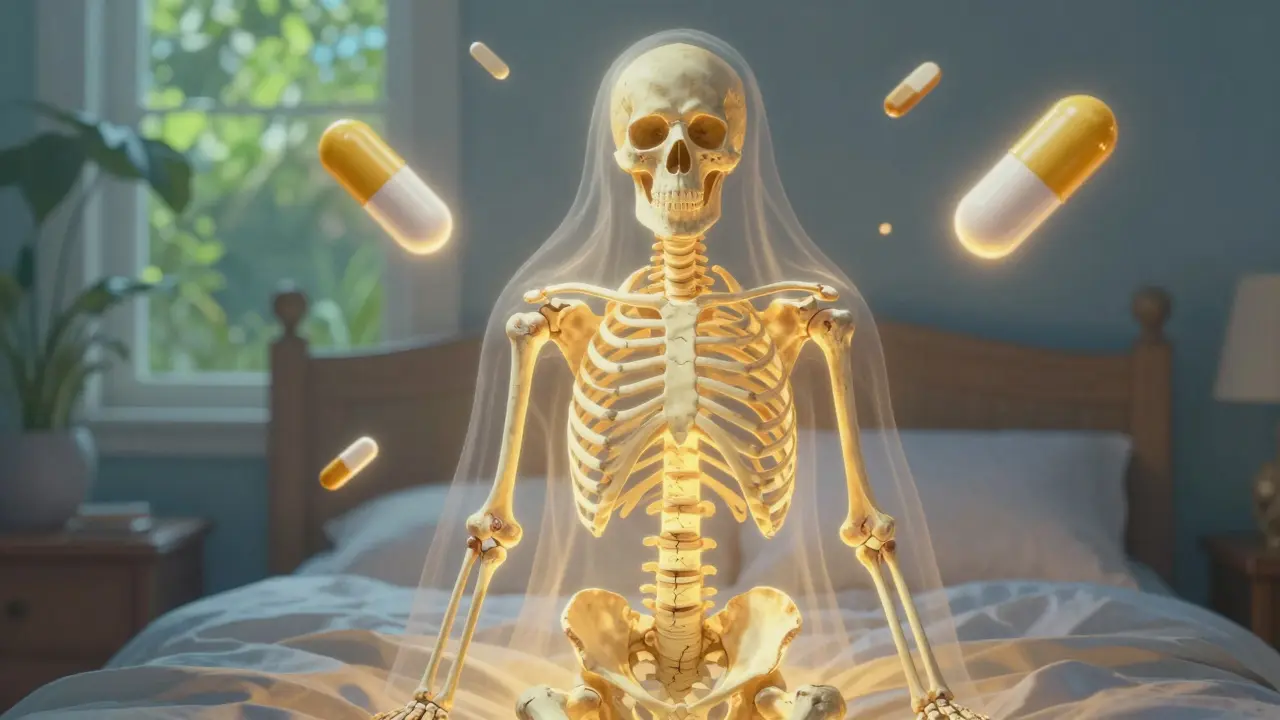
When you start taking steroids-whether for asthma, rheumatoid arthritis, or an autoimmune condition-you’re not just treating one problem. You’re also setting off a silent chain reaction in your bones. Within just a few months, your bone density can begin to drop, and your risk of fractures can jump by up to 17 times compared to someone not on these drugs. This isn’t a myth. It’s called glucocorticoid-induced osteoporosis (GIOP), and it’s the most common type of secondary osteoporosis in adults. Yet, most people don’t even know it’s happening until they break a bone. The good news? You can stop it before it starts. And the tools are simple: calcium, vitamin D, and bisphosphonates.
How Steroids Attack Your Bones
Steroids don’t just calm inflammation-they also mess with how your bones rebuild themselves. Your skeleton is always changing. Old bone is broken down by cells called osteoclasts, and new bone is built by osteoblasts. In healthy people, this balance stays steady. But when you take daily steroids, especially at doses of 2.5 mg or more of prednisone (or equivalent), that balance collapses.
Here’s what happens: about 70% of the damage comes from your osteoblasts slowing down. They stop making new bone. The rest-30%-comes from osteoclasts going into overdrive, chewing up existing bone faster than it can be replaced. This isn’t a slow process. Studies show that bone loss begins in as little as 3 to 6 months. And by the end of the first year on steroids, up to 12% of people on higher doses (7.5 mg or more) will already have suffered a vertebral fracture. That’s not rare. That’s expected.
The Foundation: Calcium and Vitamin D
If you’re on long-term steroids, calcium and vitamin D aren’t optional. They’re your first line of defense. The American College of Rheumatology (ACR) says this clearly: every single person starting steroids for three months or longer should get these two nutrients every single day.
How much? Aim for 1,000 to 1,200 milligrams of calcium daily. You can get this from dairy, leafy greens, fortified foods, or supplements. But don’t take it all at once. Your body can only absorb about 500 mg at a time. Split it-take 500 mg with breakfast and 500 mg with dinner.
Vitamin D is just as critical. Your body needs it to absorb calcium. Without enough, calcium supplements won’t work. The ACR recommends 600 to 800 IU per day. If your blood test shows you’re deficient (below 30 ng/mL), bump it up to 800-1,000 IU daily. That’s not just a suggestion. In one study, patients who took vitamin D with their steroids cut their fracture risk by nearly half compared to those who didn’t.
Here’s the catch: many people think taking a multivitamin is enough. It’s not. Most multivitamins contain only 400 IU of vitamin D. That’s half what you need. And calcium supplements vary wildly in quality. Look for brands labeled “USP Verified” or “NSF Certified.” These have been tested to make sure they actually contain what’s on the label.
The Powerhouse: Bisphosphonates
Calcium and vitamin D are the foundation. Bisphosphonates are the reinforcement. These are the only drugs proven to stop steroid-related bone loss in place. They work by sticking to bone surfaces and telling osteoclasts to calm down. They don’t build new bone-they just stop it from being destroyed.
The most common ones? Alendronate (Fosamax) and risedronate (Actonel). Both are taken as a weekly pill. Studies show they preserve bone density better than placebo. In one trial, people on alendronate gained 3.7% more bone in the spine after one year. The placebo group? They lost 1.7%. That’s not a small difference. That’s the difference between staying strong and breaking a vertebra.
For people who can’t swallow pills or have stomach issues, there’s zoledronic acid (Reclast). It’s given as a one-time IV infusion once a year. In a head-to-head trial, it improved spine bone density 4.1% more than risedronate over 12 months. It also cuts hip fracture risk by 41%. That’s huge, because oral bisphosphonates don’t reliably protect the hip.
But here’s the reality: most people stop taking them. Studies show that 50% to 70% of patients quit oral bisphosphonates within a year. Why? Side effects. They can cause heartburn, esophageal irritation, or even rare jaw problems. But the risk of not taking them? A broken spine. That’s why the guidelines say: if you can’t stick with pills, switch to the yearly IV. It’s easier. And it works just as well.

When Bisphosphonates Aren’t Enough
Not everyone responds the same. If you’re over 40, have a history of fractures, or your bone density scan (DXA) shows a T-score below -2.5, you’re in the high-risk group. For you, bisphosphonates might not be enough.
That’s where teriparatide (Forteo) comes in. Unlike bisphosphonates, teriparatide doesn’t just slow bone loss-it actually builds new bone. It’s a daily injection that mimics part of your natural parathyroid hormone. In a major 2007 study, only 0.6% of patients on teriparatide broke a bone over 18 months. In the alendronate group? 6.1%. That’s a tenfold difference.
But there’s a price tag. Teriparatide costs about $2,500 a month. Generic bisphosphonates? Around $250. It’s also limited to two years of use because of a small theoretical risk of bone cancer in rats (never seen in humans). So it’s not for everyone. But if you’ve already broken a bone or your bone density is crashing, it might be your best shot.
Another option? Denosumab (Prolia). It’s a twice-yearly injection that blocks a protein that activates bone-eating cells. It reduces vertebral fracture risk by 79%. It’s great if you can’t take bisphosphonates. But if you stop it, you can lose all the gains fast. That means you need to switch to another drug right away.
Who Gets Treatment-and Who Doesn’t
Here’s the ugly truth: only about 1 in 5 people on long-term steroids get their bones checked. And only 19% get any kind of bone protection at all. That’s not because doctors don’t know. It’s because the system doesn’t push it. A 2021 study of over 150,000 patients found that most never even got a bone density scan in their first year on steroids.
The guidelines are clear. If you’re over 40 and taking steroids for three months or more, you need treatment. If you’re under 40 but have had a prior fracture or other risk factors (smoking, low body weight, family history), you need it too. But too often, patients are left to figure it out themselves. Don’t wait. Ask your doctor for a DXA scan. Ask if you need a bisphosphonate. Ask if you’re getting enough calcium and vitamin D.
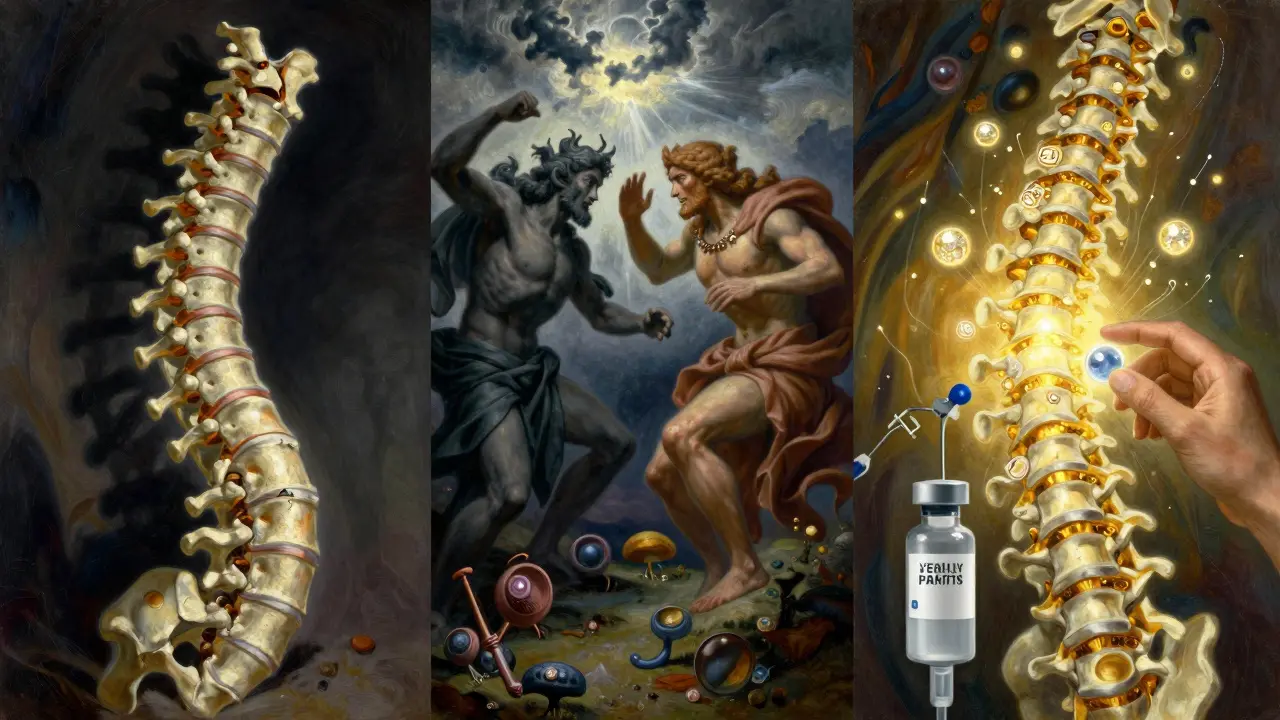
What You Need to Do Right Now
If you’re on steroids, here’s your action plan:
- Get tested. Ask for a bone density scan (DXA) of your spine and hip. Do it within 3 months of starting steroids.
- Take calcium. 1,000-1,200 mg daily, split into two doses.
- Take vitamin D. 800-1,000 IU daily, unless your blood level is normal.
- Start bisphosphonates. If you’re over 40 and on steroids for 3+ months, begin alendronate or risedronate. If you can’t swallow pills, ask about zoledronic acid.
- Follow up. Get another scan in 12 months. If your bone density dropped more than 5%, you may need a stronger option like teriparatide.
And if you’re on steroids for life? Don’t assume you’re safe. Bone loss doesn’t stop. Treatment doesn’t stop either. Most people need to stay on bisphosphonates for 3-5 years. After that, your doctor may reassess. But don’t quit without a plan.
What to Avoid
Don’t take calcium with iron or thyroid meds-they block absorption. Wait at least 2 hours between them.
Don’t lie down for 30-60 minutes after taking oral bisphosphonates. You risk burning your esophagus.
Don’t skip vitamin D. Even if you’re outside every day, sunscreen, skin tone, and latitude (yes, even in Canberra) can block your body’s ability to make it.
Don’t wait for a fracture to act. By then, it’s too late.
Can I just take calcium and vitamin D without bisphosphonates?
Calcium and vitamin D are essential, but they’re not enough on their own if you’re on long-term steroids. Studies show that without a bisphosphonate, bone density still drops by 3-5% in the first year. These nutrients help, but they don’t stop the bone loss caused by steroids. If you’re at risk-over 40, on steroids for 3+ months, or have other risk factors-you need a drug like alendronate or risedronate to protect your bones.
Are bisphosphonates safe for long-term use?
Yes, for most people. Bisphosphonates are safe for 3-5 years, and many patients take them longer. Rare side effects include atypical femur fractures (about 3-50 cases per 100,000 people per year) and jaw bone issues (less than 1 in 1,000). The risk is extremely low compared to the risk of a spine or hip fracture from untreated osteoporosis. Your doctor will monitor you and may recommend a “drug holiday” after 5 years if your bone density is stable.
Why is zoledronic acid better than oral bisphosphonates?
Zoledronic acid is given once a year as an IV infusion. It’s more effective at improving bone density, especially in the hip. It also has much better adherence-only 10% of patients stop it, compared to 70% who quit oral pills. It’s ideal for people who can’t swallow pills, have stomach issues, or struggle to take a weekly pill. It’s also the only bisphosphonate proven to reduce hip fractures in steroid users.
Do I need a bone density scan if I feel fine?
Yes. Steroid-induced bone loss happens silently. You won’t feel your bones thinning. By the time you have pain or a fracture, you’ve already lost a lot of bone. A DXA scan is the only way to catch it early. Guidelines recommend getting one within 3 months of starting long-term steroids-even if you feel perfectly healthy.
Can I stop bisphosphonates after a year?
No, not without a plan. Bone loss resumes quickly once you stop. If your bone density is stable after a year, your doctor might consider continuing treatment. If it’s still dropping, you’ll need to switch to a stronger option like teriparatide or denosumab. Never stop without discussing alternatives with your doctor.


