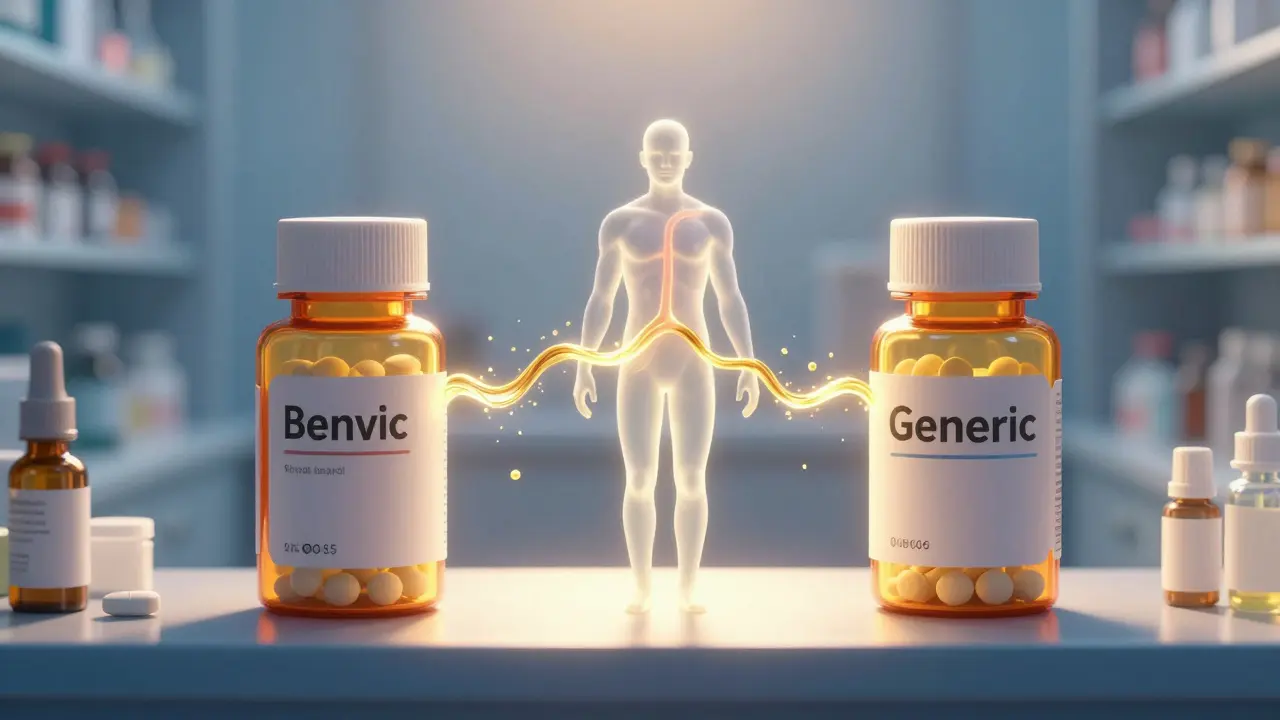
Ever switched from a brand-name pill to a generic and felt like something was off? You’re not alone. Millions of people swear their generic version doesn’t work as well - even when it’s chemically identical. This isn’t just a personal hunch. It’s a widespread belief that’s costing lives, money, and trust in the system.
The Science Says They’re the Same
Generic drugs aren’t knockoffs. They’re not cheaper because they’re weaker. They’re cheaper because they don’t need to spend millions on advertising or re-proving what’s already known. The U.S. Food and Drug Administration (FDA) requires generics to have the exact same active ingredient, strength, dosage form, and route of administration as the brand-name drug. That means if your brand-name pill has 10 mg of sertraline, the generic has 10 mg of sertraline - no more, no less. To get approved, generics must prove they’re bioequivalent. That means they release the drug into your bloodstream at the same rate and to the same extent as the brand-name version. The FDA allows a tiny variation - between 80% and 125% of the brand’s absorption - but that’s not a flaw. It’s science. For nearly all drugs, that range is clinically meaningless. Your body doesn’t notice the difference. The same factories that make brand-name drugs often make generics. The same quality controls. The same inspections. The FDA doesn’t give generics a lower standard. In fact, they’re held to the exact same Current Good Manufacturing Practices (cGMP) rules. If a generic plant fails an inspection, it’s shut down - just like a brand-name plant.Why Do People Think Generics Don’t Work?
Here’s the real problem: perception doesn’t care about science. A 2016 national survey found 13% of Americans believed brand-name drugs were more effective. Another 20% thought generics caused more side effects. Those numbers haven’t dropped much since. Why? Because our brains are wired to link cost with quality. If something costs less, we assume it’s worse. It’s not logical - but it’s human. Then there’s the nocebo effect - the opposite of placebo. If you believe a drug won’t work, your body starts to act like it doesn’t. A 2023 study in JAMA Network Open showed patients told generics were “equally effective” had 34% better adherence. Those told they were “less effective” had 41% worse adherence - even though the pills were identical. Pharmacists report patients refusing generics for chronic conditions like high blood pressure or thyroid disease, even after years of stable control on the brand. One patient stopped taking her levothyroxine after switching to generic, convinced it “didn’t work.” Blood tests later showed her hormone levels were perfectly normal. She just felt worse - because she expected to.Who’s Most Likely to Doubt Generics?
This isn’t evenly spread. People of color are significantly more skeptical. A 2015 study in the Journal of General Internal Medicine found 43% of non-Caucasian patients doubted generics were clinically equivalent, compared to 29% of white patients. Rural communities are even more affected. In Alabama’s Black Belt region, patients described generics as “for poor people,” “not real medicine,” or “weaker.” These aren’t just myths. They’re rooted in real experiences with unequal healthcare. When people have been overcharged, ignored, or given substandard care before, they don’t trust the system - especially when it suddenly pushes them toward cheaper options.
The Cost of Misunderstanding
Generics save the U.S. healthcare system about $1.7 trillion between 2009 and 2019. That’s billions of dollars that didn’t go to drug companies - and stayed in patients’ pockets. But when people refuse generics, they pay more. And when they stop taking meds because they think the generic isn’t working, they end up in the ER. A 2019 study found 22% of patients who believed generics were inferior stopped taking their meds early. Only 8% of those who didn’t hold that belief did. That’s not just a belief gap - it’s a health gap. Doctors spend an average of 3.2 minutes per prescription just explaining why the generic is fine. In low-income clinics, that time can jump to 15% of the whole visit. That’s time not spent on diet, exercise, or mental health - all things that matter just as much.How to Fix the Perception Problem
The FDA runs campaigns like “It’s the Same Medicine.” They’ve reached 27 million people. But only 19% of those people remember the message. That’s not enough. The most effective fix? Doctors and pharmacists saying it clearly - and showing it. - Show the patient the pill. Point to the active ingredient on the label. Say: “This is the same as your brand-name drug. Just cheaper.” - Hand them the FDA’s bioequivalence data. A 2022 study showed that when patients saw proof of equivalence, acceptance jumped 87%. - Talk about the nocebo effect. “Sometimes, when you expect a medicine to feel different, your body reacts that way - even if the drug hasn’t changed.” A 2023 study showed that when patients were told the generic was “just as good,” they took their meds 34% more often. That’s not magic. That’s communication.