
If you’ve ever finished a workday with burning eyes, a pounding headache, or a stiff neck, you’re not alone. More than 65% of people who use digital screens for hours every day experience symptoms of Computer Vision Syndrome (CVS)-also called digital eye strain. It’s not just tired eyes. It’s blurred vision, dryness, double vision, and even shoulder pain that creeps up after too much screen time. And with the average person spending nearly 7 hours a day on screens in 2025, this isn’t a temporary annoyance-it’s a daily reality for millions.
Why Your Eyes Are Straining (And Why It’s Not Just “Too Much Screen Time”)
It’s not just that you’re looking at screens too long. It’s how your eyes are forced to work differently on them. On paper, text has sharp edges and high contrast. On a screen? Pixels glow. Colors shift. Brightness flickers. Your eyes have to constantly refocus, and they’re doing it without your awareness.
Here’s what actually happens: your ciliary muscles-tiny muscles that adjust your lens to focus-stay locked in tight mode when staring at a monitor. At the same time, you blink less. A normal blink rate is about 15 times a minute. When you’re glued to a screen? It drops to 5. That means your tear film evaporates faster. Dry, gritty eyes? That’s why.
And then there’s posture. If your screen is too high, you’re looking up. Too low, you’re hunching. Either way, your neck and shoulders pay the price. Studies show improper screen height increases neck strain by 30% and eye fatigue by 40%. It’s not magic. It’s physics.
The 20-20-20 Rule: The Simple Fix That Actually Works
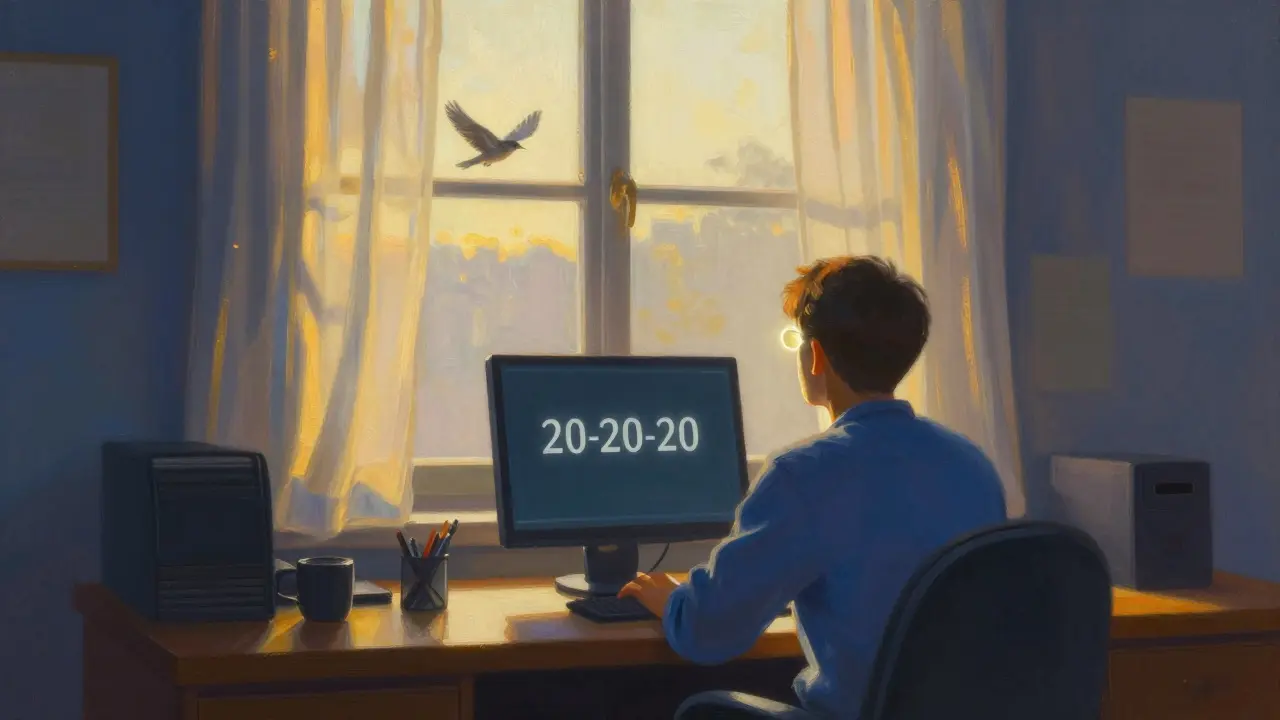
The most proven way to reduce digital eye strain isn’t expensive glasses or fancy apps. It’s the 20-20-20 rule. Every 20 minutes, look at something 20 feet away for 20 seconds. Sounds too easy? It is-and that’s why it works.
A clinical study by St. Peter Eyecare Center found people who followed this rule reduced CVS symptoms by 53%. Why? Because it gives your focusing muscles a chance to relax. It resets your visual system. You don’t need to close your eyes. You don’t need to leave your desk. Just turn your head. Look out the window. Watch a bird fly by. That’s it.
Use a free app like EyeLeo or Time Out (available for Mac and Windows) to remind you. Set it for every 20 minutes. After three weeks, you’ll notice fewer headaches. Fewer moments of blurry vision. You’ll feel less like you need a nap after lunch.
Screen Position: Where You Put Your Monitor Matters More Than You Think
Where your screen sits affects everything-your eyes, your neck, even your breathing. The ideal setup is simple:
- The top of your screen should be at or just below eye level.
- Your eyes should look slightly downward-about 15 to 20 degrees.
- Your distance from the screen? 20 to 28 inches (50-70 cm). That’s about an arm’s length.
Why? When your screen is too close, your eyes strain to focus. Too far, and you squint. Too high, and your neck tightens. Too low, and you slump. A 2023 ergonomic study from Spindel Eye Associates showed that getting this right cut eye fatigue by 40% and neck pain by 30%.
Try this: Stack books under your monitor or use a laptop stand. Adjust your chair so your arms rest comfortably. Your wrists shouldn’t bend upward. Your feet should touch the floor. It takes 15 minutes to set up. It saves you hours of pain over time.
Lighting: The Hidden Cause of Eye Strain (And How to Fix It)
Too much light? Too little? Both cause problems. Office lights at 750-1000 lux are way too bright for screen work. They create glare, washing out contrast and forcing your eyes to work harder.
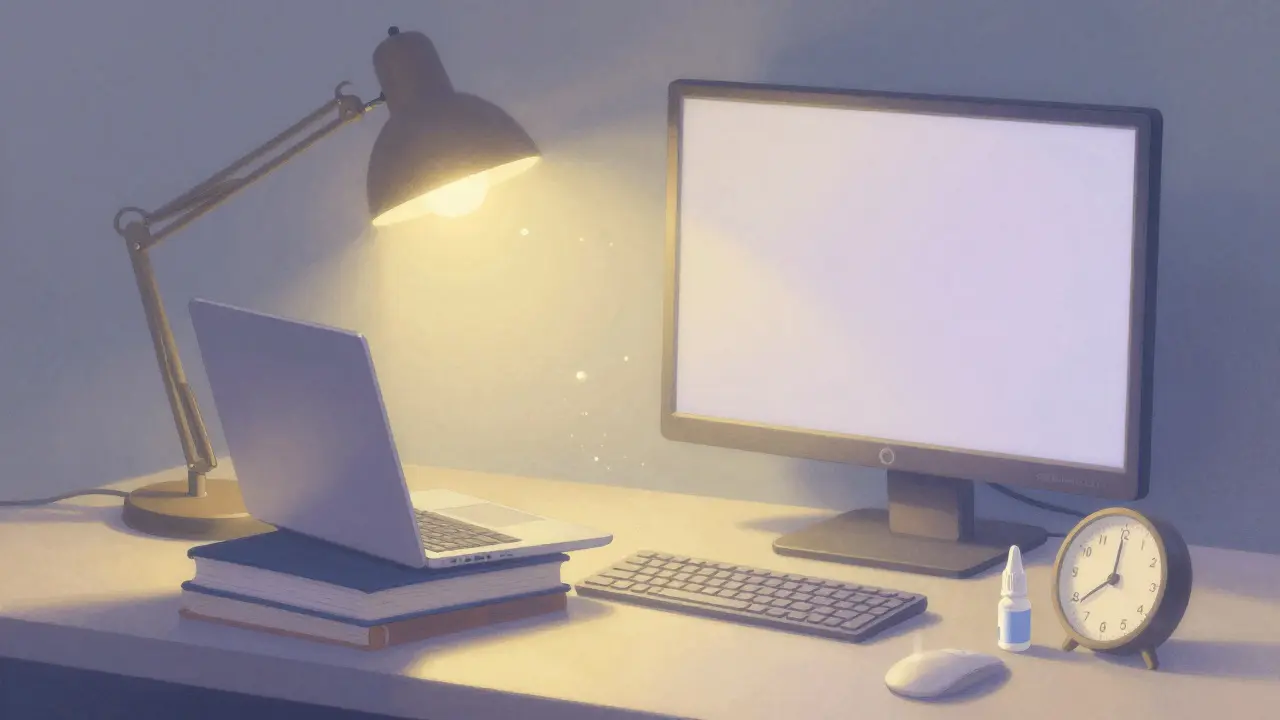
The sweet spot? 300-500 lux. That’s the brightness of a cloudy day near a window. Use ambient lighting-not direct overheads. Turn off fluorescent tubes if you can. Use a desk lamp with a warm bulb, positioned to the side, not behind you.
Glare is the silent killer. If you can see a reflection of yourself or a light on your screen, it’s too bright. Tilt your monitor slightly back. Use an anti-glare screen protector if needed. Adjust your screen brightness to match the room. If you can’t read a printed page next to your monitor without squinting, your screen is too bright.
Blue Light Glasses: Helpful or Hype?
Blue light glasses are everywhere. Online ads promise relief. Retailers sell them for $25 to $150. But here’s the truth: they’re not a magic fix.
Some users swear by them. On Reddit’s r/Bluelightglasses, 68% of users reported better comfort. But clinical trials tell a different story. A double-blind study from the American Academy of Ophthalmology found blue light filters provided only 15% more relief than clear lenses-barely better than placebo.
What they do help with? Sleep. Blue light suppresses melatonin. If you’re on screens before bed, blocking blue light can help you fall asleep faster. But for eye strain during the day? The real fixes are the 20-20-20 rule, proper lighting, and screen positioning.
Don’t waste money unless you’re also using them at night. If you have dry eyes, better lubrication and ergonomics will help more than any filter.
Eye Drops and Prescription Glasses: When You Need More Than Habits
If you’re still struggling after fixing your setup and using the 20-20-20 rule, you might have an underlying vision problem. Nearly 70% of CVS cases involve uncorrected vision-astigmatism, presbyopia, or a prescription that’s outdated.
Get a comprehensive eye exam every year. Tell your optometrist you use screens all day. They can prescribe computer-specific glasses with a different prescription than your regular ones. These are designed for the exact distance of your monitor-not for reading books or driving.
For dry eyes, preservative-free artificial tears work. Use them 2-4 times a day. A Cleveland Clinic study found 78% of users saw improvement within a week. In May 2023, the FDA approved EYSUVIS 0.25%, the first prescription eye drop specifically for digital eye strain. It’s not for everyone-but if your eyes feel like sandpaper, it’s worth asking your doctor about.
Real People, Real Results
A software developer in Sydney used the Time Out app to remind himself to look away every 20 minutes. Within three weeks, his daily headaches dropped from five days a week to one.
A graphic designer in Melbourne adjusted her monitor height to eye level. Her chronic neck pain vanished in 10 days.
A university student in Brisbane thought blue light glasses were the answer. They helped at first-but symptoms came back. Her eye exam revealed uncorrected astigmatism. New glasses fixed it.
These aren’t outliers. Cleveland Clinic’s survey of over 2,000 CVS sufferers found 89% improved when they combined multiple strategies. Only 52% improved with just one.
What’s Changing in 2025
Technology is catching up. New monitors from Dell and ASUS now come with flicker-free tech and auto-brightness adjustment. Apple’s macOS and Windows 11 have built-in screen time tools that remind you to take breaks. Even your phone can nudge you to look away.
Companies are noticing too. 68% of Fortune 500 firms now include CVS prevention in workplace wellness programs-up from 22% in 2019. Why? Because eye strain cuts productivity by up to 20%. Healthy eyes mean fewer sick days, fewer headaches, and sharper focus.
By 2025, the American Optometric Association predicts 75% of digital users will experience CVS symptoms. The good news? We know how to stop it. It’s not about avoiding screens. It’s about using them smarter.
Start Today: Your 5-Minute Action Plan
You don’t need to overhaul your life. Just do these five things now:
- Measure your screen distance. Use a tape measure. Adjust it to 20-28 inches.
- Set your screen height. The top should be at eye level or slightly below.
- Install a free reminder app (EyeLeo or Time Out). Set it for every 20 minutes.
- Turn down your screen brightness. Match it to the room. No glare.
- Use preservative-free eye drops if your eyes feel dry. Twice a day, minimum.
Do this for two weeks. Then check in: Are your eyes less tired? Fewer headaches? Better sleep? If yes, you’ve already won.
Is computer vision syndrome permanent?
No. CVS symptoms are temporary and improve once you change your habits. If you reduce screen time, follow the 20-20-20 rule, adjust your lighting, and get proper eyewear, your eyes will recover. Left untreated, symptoms can worsen and lead to chronic discomfort, but they don’t cause permanent damage to your vision.
Can children get computer vision syndrome?
Yes. Kids who spend hours on tablets or laptops for school or gaming are just as vulnerable. Their eyes are still developing, and they often don’t realize they’re straining. Parents should enforce screen breaks, ensure proper screen height, and limit non-educational screen time. Annual eye exams are just as important for children as they are for adults.
Do I need special computer glasses?
Not necessarily. If you have no vision problems, regular breaks and proper screen setup are enough. But if you wear glasses or contacts, ask your optometrist about computer-specific lenses. These are designed for the distance of your monitor and can reduce eye fatigue significantly. Blue light coatings help with sleep but aren’t essential for daytime eye strain.
Why do my eyes feel dry even when I blink?
Because you’re not blinking fully. When you’re focused on a screen, your blinks become shallow and incomplete. That means your tear film doesn’t spread properly. The solution? Practice full blinks every few seconds. Close your eyes slowly, hold for a second, then open. Do this for 30 seconds every hour. It helps more than drops alone.
Can screen time cause long-term damage to my eyes?
Current research shows no evidence that screen use causes permanent eye damage like macular degeneration or cataracts. But it can lead to chronic discomfort, reduced productivity, and worsening dry eye syndrome. The goal isn’t to avoid screens-it’s to use them in a way that doesn’t exhaust your eyes. Think of it like posture: you wouldn’t sit slouched all day and expect your back to be fine. Your eyes need the same care.
What to Do Next
If you’re still struggling after trying these steps, schedule a comprehensive eye exam. Tell your optometrist you use screens all day. Ask about computer-specific prescriptions. Check your workspace lighting. Set up your reminders. Your eyes won’t heal on their own-but they’ll recover fast if you give them the right conditions.
There’s no need to quit your job or ditch your phone. Just adjust how you use them. Your eyes will thank you-in days, not years.


